
Molecular epidemiology of sequence type 33 of Shiga toxin-producing Escherichia coli O91:H14 isolates from human patients and retail meats in Korea
- Affiliations
-
- 1College of Veterinary Medicine and Institute of Veterinary Science, Kangwon National University, Chuncheon 24341, Korea. jwy706@kangwon.ac.kr
- 2Division of Bacterial Disease Research, Center for Infectious Diseases Research, Korea National Institute of Health, Centers for Disease Control and Prevention, Cheongju 28159, Korea. micro487@hanmail.net
- 3Division of Bacterial Disease, Center for Laboratory Control of Infectious Diseases, Center for Disease Control and Prevention, Cheongju 28159, Korea.
- KMID: 2434782
- DOI: http://doi.org/10.4142/jvs.2019.20.1.87
Abstract
- Sequence type (ST) 33 of Shiga toxin-producing Escherichia coli (STEC) strain O91:H14 has been proposed as a potential domestic clone of STEC in Korea because of its high prevalence among human patients with mild diarrhea or asymptomatic carriers. Herein, the clonal diversity of 17 STEC O91:H14 isolates of ST33 during 2003 to 2014 was analyzed by pulsed-field gel electrophoresis, including 14 isolates from human patients and 3 from retail meats. Their virulence characteristics, acid resistance, and antimicrobial susceptibility were also determined. Our results showed that all isolates were clustered mainly into three different pulsotypes and were likely low pathogenic without antimicrobial resistance.
Keyword
MeSH Terms
Figure
-
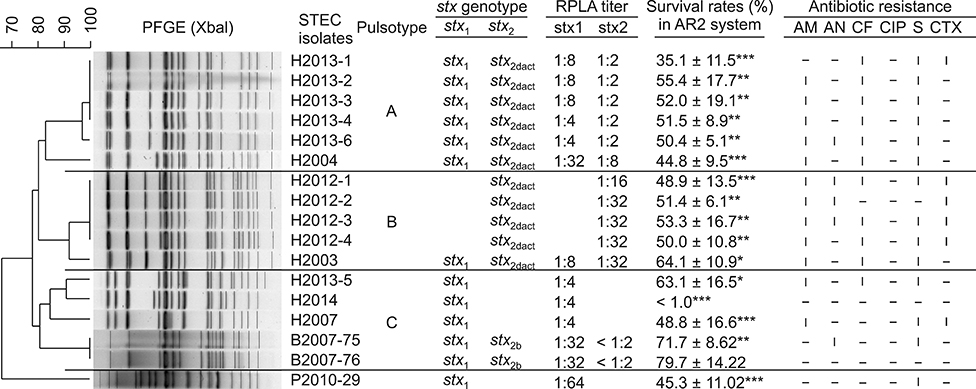
Fig. 1 Pulsed-field gel electrophoresis (PFGE) profiles and virulence characteristics of the 17 Shiga toxin-producing Escherichia coli (STEC) O91:H14 isolates with sequence type 33. The data, including multilocus sequence types, stx genotypes, reverse passive latex agglutination (RPLA) titers of Shiga toxins (Stxs), glutamate-induced acid resistance, and antibiotic resistance phenotypes, were combined and presented with the pulsotypes. The STEC isolates were divided into three pulsotypes (A to C) based on > 80% similarity of PFGE profiles. The RPLA titers of Stxs and the acid survival rates (AR2) were quantitated and compared with those of EDL933, which produced both Stx1 and Stx2 (1:16 and ≥ 1:128 RPLA titers, respectively) as well as surviving well in EG media (pH 2.5) with 1.5 mM glutamate. AM, ampicillin; AN, amikacin; CF, cephalothin; CIP, ciprofloxacin; S, streptomycin; CTX, cefotaxime; I, intermediate resistance. *p < 0.05, significantly different from EDL933; **p < 0.01, significantly different from EDL933; ***p < 0.001, significantly different from EDL933.
Reference
-
1. Bettelheim KA. The non-O157 Shiga-Toxigenic (Verocytotoxigenic) Escherichia coli; under-rated pathogens. Crit Rev Microbiol. 2007; 33:67–87.
Article2. Bielaszewska M, Stoewe F, Fruth A, Zhang W, Prager R, Brockmeyer J, Mellmann A, Karch H, Friedrich AW. Shiga toxin, cytolethal distending toxin, and hemolysin repertoires in clinical Escherichia coli O91 isolates. J Clin Microbiol. 2009; 47:2061–2066.
Article3. Brooks JT, Sowers EG, Wells JG, Greene KD, Griffin PM, Hoekstra RM, Strockbine NA. Non-O157 Shiga toxin-producing Escherichia coli infections in the United States,1983-2002. J Infect Dis. 2005; 192:1422–1429.
Article4. Cergole-Novella MC, Nishimura LS, Dos Santos LF, Irino K, Vaz TM, Bergamini AM, Guth BE. Distribution of virulence profiles related to new toxins and putative adhesins in Shiga toxin-producing Escherichia coli isolated from diverse sources in Brazil. FEMS Microbiol Lett. 2007; 274:329–334.
Article5. Eichhorn I, Heidemanns K, Semmler T, Kinnemann B, Mellmann A, Harmsen D, Anjum MF, Schmidt H, Fruth A, Valentin-Weigand P, Heesemann J, Suerbaum S, Karch H, Wieler LH. Highly virulent Non-O157 enterohemorrhagic Escherichia coli (EHEC) serotypes reflect similar phylogenetic lineages, providing new insights into the evolution of EHEC. Appl Environ Microbiol. 2015; 81:7041–7047.
Article6. Ferdous M, Friedrich AW, Grundmann H, de Boer RF, Croughs PD, Islam MA, Kluytmans-van den Bergh MF, Kooistra-Smid AM, Rossen JW. Molecular characterization and phylogeny of Shiga toxin-producing Escherichia coli isolates obtained from two Dutch regions using whole genome sequencing. Clin Microbiol Infect. 2016; 22:642.e1–642.e9.7. Hauser E, Mellmann A, Semmler T, Stoeber H, Wieler LH, Karch H, Kuebler N, Fruth A, Harmsen D, Weniger T, Tietze E, Schmidt H. Phylogenetic and molecular analysis of food-borne shiga toxin-producing Escherichia coli. Appl Environ Microbiol. 2013; 79:2731–2740.
Article8. Lee JB, Han D, Lee HT, Wi SM, Park JH, Jo JW, Cho YJ, Hahn TW, Lee S, Kang B, Kwak HS, Kim J, Yoon JW. Pathogenic and phylogenetic characteristics of non-O157 Shiga toxin-producing Escherichia coli isolates from retail meats in South Korea. J Vet Sci. 2018; 19:251–259.
Article9. Lindgren SW, Samuel JE, Schmitt CK, O'Brien AD. The specific activities of Shiga-like toxin type II (SLT-II) and SLT-II-related toxins of enterohemorrhagic Escherichia coli differ when measured by Vero cell cytotoxicity but not by mouse lethality. Infect Immun. 1994; 62:623–631.
Article10. Maeda E, Murakami K, Etoh Y, Onozuka D, Sera N, Asoshima N, Honda M, Narimatsu H, Iyoda S, Watahiki M, Fujimoto S. Does sequence type 33 of Shiga toxin-producing Escherichia coli O91 cause only mild symptoms? J Clin Microbiol. 2015; 53:362–364.
Article11. Mellmann A, Fruth A, Friedrich AW, Wieler LH, Harmsen D, Werber D, Middendorf B, Bielaszewska M, Karch H. Phylogeny and disease association of Shiga toxin-producing Escherichia coli O91. Emerg Infect Dis. 2009; 15:1474–1477.
Article12. Merkel V, Ohder B, Bielaszewska M, Zhang W, Fruth A, Menge C, Borrmann E, Middendorf B, Müthing J, Karch H, Mellmann A. Distribution and phylogeny of immunoglobulin-binding protein G in Shiga toxin-producing Escherichia coli and its association with adherence phenotypes. Infect Immun. 2010; 78:3625–3636.
Article13. Nataro JP, Kaper JB. Diarrheagenic Escherichia coli. Clin Microbiol Rev. 1998; 11:142–201.14. Werber D, Behnke SC, Fruth A, Merle R, Menzler S, Glaser S, Kreienbrock L, Prager R, Tschäpe H, Roggentin P, Bockemühl J, Ammon A. Shiga toxin-producing Escherichia coli infection in Germany: different risk factors for different age groups. Am J Epidemiol. 2007; 165:425–434.
Article15. Werber D, Beutin L, Pichner R, Stark K, Fruth A. Shiga toxin-producing Escherichia coli serogroups in food and patients, Germany. Emerg Infect Dis. 2008; 14:1803–1806.
Article
- Full Text Links
-
- Actions
-
Cited
- CITED
-
- Close
- Share
-
- Similar articles
-
- Pathogenic and phylogenetic characteristics of non-O157 Shiga toxin-producing Escherichia coli isolates from retail meats in South Korea
- Prevalence of Salmonella enterica and Shiga toxin-producing Escherichia coli in zoo animals from Chile
- Epidemiological Analysis of Shiga Toxin-producing E. coli Isolated in Gwangju, Korea, by Pulse-field Gel Electrophoresis
- Molecular Genetic Characterization of Shiga Toxin-producing E. coli Isolated from Diarrhea Patients and Cattle in Gwangju Area, Korea
- Virulence factors in Escherichia coli isolated from calves with diarrhea in Vietnam


