
Effect of Sasa quelpaertensis Nakai Extracts and its Constituent p-coumaric Acid on the Apoptosis of Human Cancer Cell Lines
- Affiliations
-
- 1Jeju Sasa Industry Development Agency, Jeju National University, 102 Jejudaehakno, Jeju-si Special Self-Governing Province 63243, Korea. sjkim@jejunu.ac.kr
- 2Department of Biology, Jeju National University, 102 Jejudaehakno, Jeju-si Special Self-Governing Province, 63243, Korea.
- KMID: 2432426
- DOI: http://doi.org/10.20307/nps.2018.24.4.293
Abstract
- Sasa quelpaertensis Nakai leaves contain a mixture of polysaccharides, amino acids, and polyphenols, which mediate various biological activities. For efficient utilization of its leaf, we reported the preparation procedure for phytochemical-rich extract (PRE) using the leaf residue, which was by-product of hot water extraction. This study was undertaken to evaluate the effects of PRE and its major constituent, p-coumaric acid,on the growth of several human cancer cell lines (MKN-74, MKN-45, SNU-1, SNU-16, and HL-60). The ethyl acetate fraction of PRE and p-coumaric acid significantly inhibited the proliferation of MKN-74 and HL-60 cells, respectively, and induced cell apoptosis, down-regulated Bcl-2 and poly (ADP-ribose) polymerase levels, and up-regulated those of Bax and caspase-3. These results show the potential utility of S. quelpaertensis Nakai leaves in cancer prevention.
MeSH Terms
Figure
-
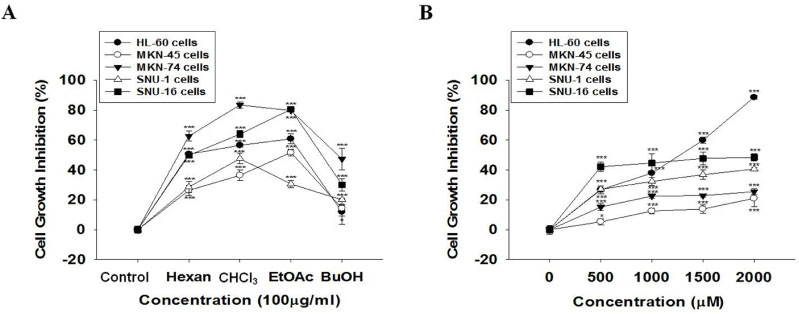
Fig. 1 Growth-inhibiting effects of phytochemical-rich extract (PRE) fraction (A) and p-coumaric acid (B) on the several human cancer cell lines. Data are means ± standard deviation (SD) of three independent experiments. ***p < 0.001, **p < 0.01, and *p < 0.05 compared to the untreated group.

Fig. 2 Apoptosis inducing effects of ethyl acetate fraction of PRE (EPRE) (A) and p-coumaric acid (B) in HL-60 cells. Data (means ± SD of triplicate determinations) are representative of at least three independent experiments. ***p < 0.001 compared to the untreated group. (A) PRE, (B) p-coumaric acid.
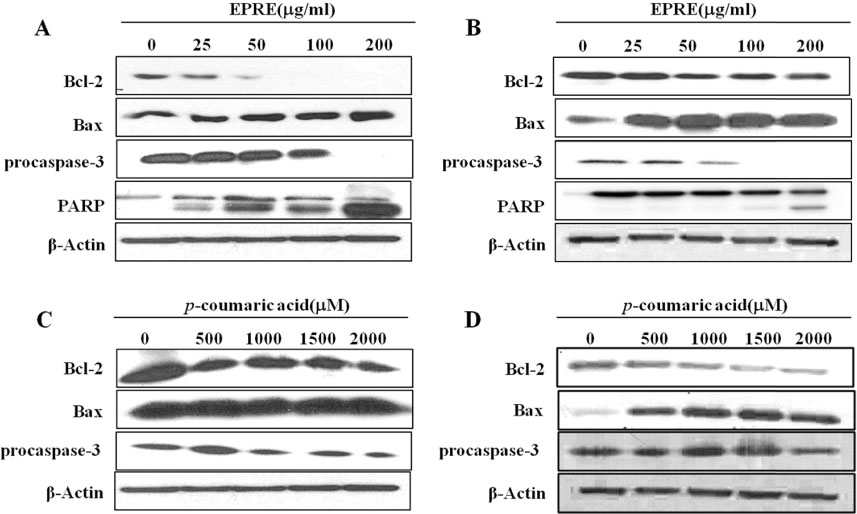
Fig. 3 Effects of ethyl acetate fraction of PRE (EPRE) and p-coumaric acid on the expression of apoptosis-related proteins in MKN-74 cells (A, C) and HL-60 cells (B, D).
Reference
-
1. Doll R. Cancer Res. 1992; 52:2024S–2029S.2. Jemal A, Bray F, Center MM, Ferlay J, Ward E, Forman D. CA Cancer J Clin. 2011; 61:69–90.3. Kim EJ, Part H, Lim SS, Kim JS, Shin HK, Yoon JH. Korean J Food Sci Technol. 2008; 40:207–214.4. Fulda S, Debatin KM. Curr Cancer Drug Targets. 2004; 4:569–576.5. Ji YB, Qu ZY, Zou X. Exp Toxicol Pathol. 2011; 63:69–78.6. Shinkai K, Akedo H, Mukai M, Imamura F, Isoai A, Kobayashi M, Kitagawa I. Jpn J Cancer Res. 1996; 87:357–362.7. Ahmad N, Feyes DK, Nieminen AL, Agarwal R, Mukhtar H. J Natl Cancer Inst. 1997; 89:1881–1886.8. Hwang JH, Choi SY, Ko HC, Jang MG, Jin YJ, Kang SI, Park JG, Chung WS, Kim SJ. Food Sci Biotechnol. 2007; 16:728–733.9. Jang MG, Park SY, Lee SR, Choi SY, Hwang JH, Ko HC, Park JG, Chung WS, Kim SJ. Food Sci Biotechnol. 2008; 17:188–190.10. Kim M, Kim YS, Kim KM, Ko HC, Kim SJ, Kim JH, Kim Y. Integr Cancer Ther. 2014; 13:529–540.11. Kim A, Bing SJ, Cho J, Herath K, Ahn G, Park E, Kim MJ, Kim DS, Kim JS, Lee NH, Jee Y. J Prev Vet Med. 2015; 39:169–174.12. Lee JY, Ko HC, Jang MG, Kim SJ. J Life Sci. 2016; 26:1330–1335.13. Kang SW, Kang SI, Shin HS, Yoon SA, Kim JH, Ko HC, Kim SJ. Food Chem Toxicol. 2013; 59:380–385.14. Kim A, Bing SJ, Cho J, Herath K, Ahn G, Park E, Kim MJ, Kim DS, Kim JS, Lee NH, Jee Y. J Prev Vet Med. 2016; 39:169–174.15. Janicke B, Onning G, Oredsson SM. J Agric Food Chem. 2005; 53:6658–6665.16. Jaganathan SK, Supriyanto E, Mandal M. World J Gastroenterol. 2013; 19:7726–7734.17. Liu MH, Ko CH, Ma N, Tan PW, Fu WM, He JY. J Funct Foods. 2016; 22:533–546.18. Hunt A, Evan G. Science. 2001; 293:1784–1785.19. Burlacu A. J Cell Mol Med. 2003; 7:249–257.20. Kuwana T, Mackey MR, Perkins G, Ellisman MH, Latterich M, Schneiter R, Green DR, Newmeyer DD. Cell. 2002; 111:331–342.21. Green DR, Reed JC. Science. 1998; 281:1309–1312.22. Fernandes-Alnemri T, Litwack G, Alnemri ES. J Biol Chem. 1994; 269:30761–30764.
- Full Text Links
-
- Actions
-
Cited
- CITED
-
- Close
- Share
-
- Similar articles
-
- Sasa quelpaertensis Nakai ethyl acetate fraction protects the liver against chronic alcohol-induced liver injury and fat accumulation in mice
- Intestinal anti-inflammatory activity of Sasa quelpaertensis leaf extract by suppressing lipopolysaccharide-stimulated inflammatory mediators in intestinal epithelial Caco-2 cells co-cultured with RAW 264.7 macrophage cells
- Induction of Apoptosis and Inhibition of Cellular Proliferation in Aspirin-treated SNU-668 Human Gastric Adenocarcinoma Cell Lines
- Effect of Inonotus Obliques Extracts on Proliferation and Caspase-3 Activity in Human Castro-Intestinal Cancer Cell Lines
- Apoptosis and Cell Cycle Arrest with EGF, TGF- a and TGF- 8 in Cervical Cancer Cell Lines


