
Korean J Orthod.
2018 May;48(3):200-211. 10.4041/kjod.2018.48.3.200.
The effectiveness of corticotomy and piezocision on canine retraction: A systematic review

- Affiliations
-
- 1Department of Orthodontics, Faculty of Dentistry, Mahidol University, Bangkok, Thailand. nitaviw@hotmail.com
- 2Private Practice, Bangkok, Thailand.
- KMID: 2418331
- DOI: http://doi.org/10.4041/kjod.2018.48.3.200
Abstract
- The aim of this systematic review was to evaluate the effectiveness and complications of corticotomy and piezocision in canine retraction. Five electronic databases (PubMed, SCOPUS, Web of Science, Embase, and CENTRAL) were searched for articles published up to July 2017. The databases were searched for randomized control trials (RCTs), with a split-mouth design, using either corticotomy or piezocision. The primary outcome reported for canine retraction was either the amount of tooth movement, rate of tooth movement, or treatment time. The secondary outcome was complications. The selection process was based on the PRISMA guidelines. A risk of bias assessment was also performed. Our search retrieved 530 abstracts. However, only five RCTs were finally included. Corticotomy showed a more significant (i.e., 2 to 4 times faster) increase in the rate of tooth movement than did the conventional method. For piezocision, both accumulative tooth movement and rate of tooth movement were twice faster than those of the conventional method. Corticotomy (with a flap design avoiding marginal bone incision) or flapless piezocision procedures were not detrimental to periodontal health. Nevertheless, piezocision resulted in higher levels of patient satisfaction. The main limitation of this study was the limited number of primary research publications on both techniques. For canine retraction into the immediate premolar extraction site, the rate of canine movement after piezocision was almost comparable to that of corticotomy with only buccal flap elevation.
Figure
-
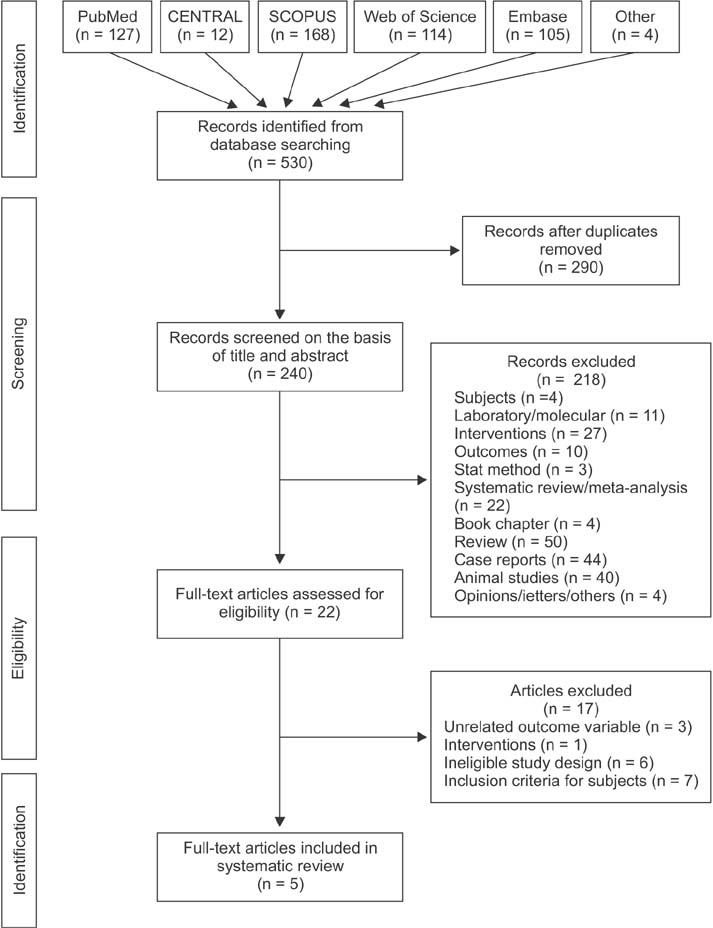
Figure 1 PRISMA (Preferred Reporting Items for Systematic Reviews and Meta-analyses) flow chart for the systematic review. CENTRAL, Cochrane Central Register of Controlled Trials.
Cited by 1 articles
-
Corticotomy for orthodontic tooth movement
Won Lee
J Korean Assoc Oral Maxillofac Surg. 2018;44(6):251-258. doi: 10.5125/jkaoms.2018.44.6.251.
Reference
-
1. Wilcko WM, Wilcko T, Bouquot JE, Ferguson DJ. Rapid orthodontics with alveolar reshaping: two case reports of decrowding. Int J Periodontics Restorative Dent. 2001; 21:9–19.2. Kim SJ, Park YG, Kang SG. Effects of Corticision on paradental remodeling in orthodontic tooth movement. Angle Orthod. 2009; 79:284–291.
Article3. Park YG, Kang SG, Kim SI. Accelerated tooth movement by corticision as an osseous orthodontic paradigm. Kinki Tokai Kyosei Shika Gakkai Gakujyutsu Taikai, Sokai. 2006; 28:6.4. Alikhani M, Raptis M, Zoldan B, Sangsuwon C, Lee YB, Alyami B, et al. Effect of micro-osteoperforations on the rate of tooth movement. Am J Orthod Dentofacial Orthop. 2013; 144:639–648.
Article5. Kim YS, Kim SJ, Yoon HJ, Lee PJ, Moon W, Park YG. Effect of piezopuncture on tooth movement and bone remodeling in dogs. Am J Orthod Dentofacial Orthop. 2013; 144:23–31.
Article6. Dibart S. Piezocision™: Accelerating orthodontic tooth movement while correcting hard and soft tissue deficiencies. Front Oral Biol. 2016; 18:102–108.
Article7. Hassan AH, Al-Fraidi AA, Al-Saeed SH. Corticotomy-assisted orthodontic treatment: review. Open Dent J. 2010; 4:159–164.
Article8. Aboul-Ela SM, El-Beialy AR, El-Sayed KM, Selim EM, El-Mangoury NH, Mostafa YA. Miniscrew implant-supported maxillary canine retraction with and without corticotomy-facilitated orthodontics. Am J Orthod Dentofacial Orthop. 2011; 139:252–259.
Article9. Al-Naoum F, Hajeer MY, Al-Jundi A. Does alveolar corticotomy accelerate orthodontic tooth movement when retracting upper canines? A split-mouth design randomized controlled trial. J Oral Maxillofac Surg. 2014; 72:1880–1889.
Article10. Bhattacharya P, Bhattacharya H, Anjum A, Bhandari R, Agarwal DK, Gupta A, et al. Assessment of corticotomy facilitated tooth movement and changes in alveolar bone thickness - A CT scan study. J Clin Diagn Res. 2014; 8:ZC26–ZC30.11. Sakthi SV, Vikraman B, Shobana VR, Iyer SK, Krishnaswamy NR. Corticotomy-assisted retraction: an outcome assessment. Indian J Dent Res. 2014; 25:748–754.
Article12. Wu J, Jiang JH, Xu L, Liang C, Bai Y, Zou W. A pilot clinical study of Class III surgical patients facilitated by improved accelerated osteogenic orthodontic treatments. Angle Orthod. 2015; 85:616–624.
Article13. Shoreibah EA, Ibrahim SA, Attia MS, Diab MM. Clinical and radiographic evaluation of bone grafting in corticotomy-facilitated orthodontics in adults. J Int Acad Periodontol. 2012; 14:105–113.14. Fischer TJ. Orthodontic treatment acceleration with corticotomy-assisted exposure of palatally impacted canines. Angle Orthod. 2007; 77:417–420.
Article15. Ma Z, Xu G, Yang C, Xie Q, Shen Y, Zhang S. Efficacy of the technique of piezoelectric corticotomy for orthodontic traction of impacted mandibular third molars. Br J Oral Maxillofac Surg. 2015; 53:326–331.
Article16. Vercellotti T, Podesta A. Orthodontic microsurgery: a new surgically guided technique for dental movement. Int J Periodontics Restorative Dent. 2007; 27:325–331.17. Yaffe A, Fine N, Binderman I. Regional accelerated phenomenon in the mandible following mucoperiosteal flap surgery. J Periodontol. 1994; 65:79–83.
Article18. Vercellotti T. Piezoelectric surgery in implantology: a case report--a new piezoelectric ridge expansion technique. Int J Periodontics Restorative Dent. 2000; 20:358–365.19. Charavet C, Lecloux G, Bruwier A, Rompen E, Maes N, Limme M, et al. Localized piezoelectric alveolar decortication for orthodontic treatment in adults: a randomized controlled trial. J Dent Res. 2016; 95:1003–1009.
Article20. Higgins JP, Altman DG, Gøtzsche PC, Jüni P, Moher D, Oxman AD, et al. The Cochrane Collaboration's tool for assessing risk of bias in randomised trials. BMJ. 2011; 343:d5928.
Article21. Abbas NH, Sabet NE, Hassan IT. Evaluation of corticotomy-facilitated orthodontics and piezocision in rapid canine retraction. Am J Orthod Dentofacial Orthop. 2016; 149:473–480.
Article22. Aksakalli S, Calik B, Kara B, Ezirganli S. Accelerated tooth movement with piezocision and its periodontal-transversal effects in patients with Class II malocclusion. Angle Orthod. 2016; 86:59–65.
Article23. Jahanbakhshi MR, Motamedi AM, Feizbakhsh M, Mogharehabed A. The effect of buccal corticotomy on accelerating orthodontic tooth movement of maxillary canine. Dent Res J (Isfahan). 2016; 13:303–308.
Article24. Patterson BM, Dalci O, Darendeliler MA, Papadopoulou AK. Corticotomies and orthodontic tooth movement: a systematic review. J Oral Maxillofac Surg. 2016; 74:453–473.
Article25. Lee W, Karapetyan G, Moats R, Yamashita DD, Moon HB, Ferguson DJ, et al. Corticotomy-/osteotomy-assisted tooth movement microCTs differ. J Dent Res. 2008; 87:861–867.
Article26. Mühlemann HR. Tooth mobility: a review of clinical aspects and research findings. J Periodontol. 1967; 38:Suppl686–713.
Article27. Abu-Hussein M, Watted N, Hegedus V, Boorbely P. Corticotomy in the modern orthodontics. IOSRJDMS. 2015; 14:68–80.28. Nowzari H, Yorita FK, Chang HC. Periodontally accelerated osteogenic orthodontics combined with autogenous bone grafting. Compend Contin Educ Dent. 2008; 29:200–206.29. Gantes B, Rathbun E, Anholm M. Effects on the periodontium following corticotomy-facilitated orthodontics. Case reports. J Periodontol. 1990; 61:234–238.
Article30. Cassetta M, Di Carlo S, Giansanti M, Pompa V, Pompa G, Barbato E. The impact of osteotomy technique for corticotomy-assisted orthodontic treatment (CAOT) on oral health-related quality of life. Eur Rev Med Pharmacol Sci. 2012; 16:1735–1740.
- Full Text Links
-
- Actions
-
Cited
- CITED
-
- Close
- Share
-
- Similar articles
-
- Use of corticotomy for canine and molar retraction
- The study of efficiency of corticotomy in treatment of bimaxillary protrusion
- A study on initial changes during canine retraction by the finite element method
- Histologic assessment of the biological effects after speedy surgical orthodontics in a beagle animal model: a preliminary study
- The pattern of movement and stress distribution during retraction of maxillary incisors using a 3-D finite element method


