Korean J Adult Nurs.
2014 Feb;26(1):46-57. 10.7475/kjan.2014.26.1.46.
The Relationship of Gender Role Conflict and Job Satisfaction upon Organizational Commitment in Male Nurses
- Affiliations
-
- 1The Graduate School, Ewha Womans University, Seoul, Korea.
- 2Division of Nursing Science, College of Health Sciences, Ewha Womans University, Seoul, Korea. mykim0808@ewha.ac.kr
- KMID: 2351589
- DOI: http://doi.org/10.7475/kjan.2014.26.1.46
Abstract
- PURPOSE
This study was to investigate the influence of male nurses' gender role conflict and job satisfaction on their organizational commitment.
METHODS
Data were collected through a mixed method design using structured questionnaires (N=162) and a sequential qualitative interviews (N=8) from 2nd October, 2012 to 7th February, 2013. Data analysis included t-test, ANOVA, regression with SPSS/WIN 19.0 program and a qualitative thematic analysis.
RESULTS
Factors affecting participants' organizational commitment were job satisfaction and marital status which accounted for 36.2% of the total variance. In particular, low job satisfaction was not correlated with low organizational commitment despite lower job satisfaction. Three main themes connoting meanings of ambivalence were extracted from the data: desiring for the better future in spite of the current difficulty, strengthening their masculinity in tandem with complementing femininity in the midst of gender role conflict, leading their organization at times, and enduring hard work with responsibility for raising their family as a head of household.
CONCLUSION
The findings indicate that male nurses' adjustment to the organization is controlled by ambivalence. It is essential to understand sociocultural contexts of male nurses as a minority in nursing fields for further research.
MeSH Terms
Figure
-
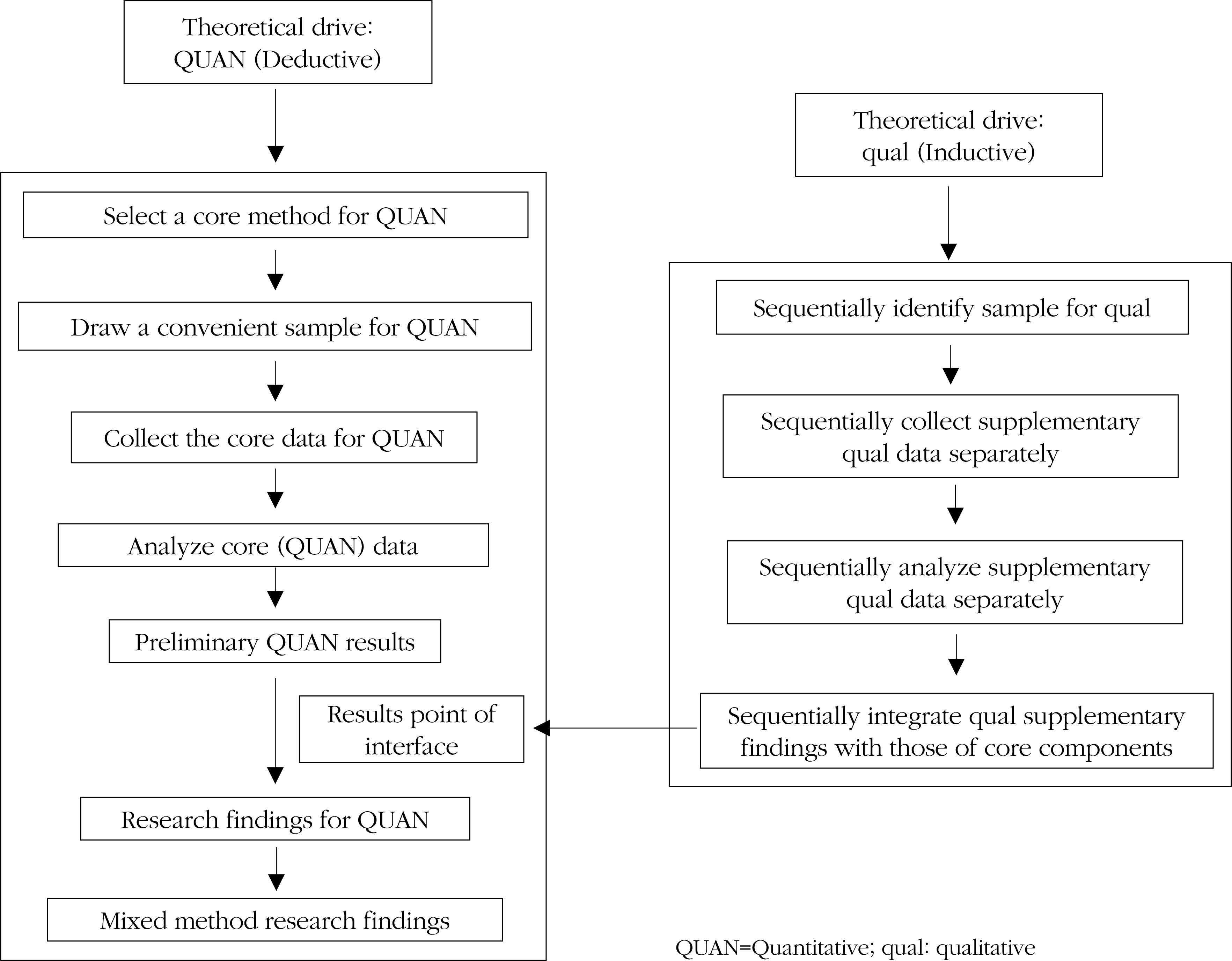
Figure 1. Mixed method design guided by a deductive core component (QUAN) and a sequential inductive supplemental component (qual).
Cited by 1 articles
-
A Prediction Model on the Male Nurses’ Turnover Intention
Su Ol Kim, Younhee Kang
Korean J Adult Nurs. 2016;28(5):585-594. doi: 10.7469/kjan.2016.28.5.585.
Reference
-
An E. S.., Chu S. K.2011. Study on male nurses' gender stereotype and job satisfaction. Journal of Korean Academy of Nursing Administration. 17(1):14–21.
ArticleBraun V.., Clarke V.2006. Using thematic analysis in psychology. Qualitative Research in Psychology. 3:77–101.
ArticleChen S. H.., Fu C. M.., Li R. H.., Lou J. H.., Yu H. Y.2012a. Relationships among social support, professional empowerment, and nursing career development of male nurses: A cross-sectional analysis. Western Journal of Nursing Research. 34(7):862–882. http://dx.doi.org/10.1177/0193945910384603.Chen S. H.., Yu H. Y.., Hsu H. Y.., Lin F. C.., Lou J. H.2012b. Organisational support, organisational identification and organisational citizenship behaviour among male nurses. Journal of Nursing Management, 1-11. http://dx.doi.org/10.1111/j.1365-2834.2012.01449.x.
ArticleChoi J. H.2012. Related factors the job satisfaction, burnout and turnover intention of male nurses. Unpublished master's thesis, Dong A University, Busan.Chung K. S.2012, May 10. Korea male nurses state. The Korean Nurses Association News. p.1.Han C. B.., Moon H. J.1996. A study on role conception and job satisfaction of clinical nurses. Journal of Korean Academy of Nursing Administration. 2(1):115–124.Herakova L. L.2012. Nursing nasculinity: Male nurses' experiences through a co-cultural lens. Howard Journal of Communications. 23(4):332–350. http://dx.doi.org/10.1080/10646175.2012.722822.Kim J. H.., Hwang M. H.., Ryu J. Y.2004. Gender roles, gender role conflicts, career indecision and vocational identity of Korean male college students in male-dominant majors and in female-dominant majors. The Korea Journal of Youth Counseling. 12(1):132–142.Kim K. J.1986. An empirical study on the turnover decision process model. Unpublished master's thesis, Korea University, Seoul.Kim M. Y.2009. An exploratory study of masculinity in nursing. Journal of Korean Clinical Nursing Research. 15(2):37–46.Kitto S.., Chesters J.., Grbich C.2008. Quality in qualitative research. Criteria for authors and assessors in the submission and assessment of qualitative research articles for the Medical Journal of Australia. Medical Journal of Australia. 188(4):243–246.Lee E. Y.., Kim N. H.2012. Relationship among nurses' attitude on job rotation, job stress and organizational commitment. Korean Journal of Occupational Health Nursing. 21(2):154–163.
ArticleLee S. S.2010. The effects of male nurses of hospital organization culture on the level of job satisfaction. Unpublished master's thesis, The Catholic University of Korea, Seoul.Lee S. Y.2004. A study on job satisfaction and intentions of turnover of male nurses. Unpublished master's thesis, Hanyang University, Seoul.Lee S. Y.., Kim I. S.., Kim J. H.2011. Development of Korean male gender role conflict scale. Seoul: Korean Women's Development Institute.Liou S. R.2008. An analysis of the concept of organizational commitment. Nursing Forum. 43(3):116–125. http://dx.doi.org/10.1111/j.1744-6198.2008.00103.x.
ArticleLou J. H.., Li R. H.., Yu H. Y.., Chen S. H.2011. Relationships among self-esteem, job adjustment and service attitude amongst male nurses: A structural equation model. Journal of Clinical Nursing. 20:864–872. http://dx.doi.org/10.1111/j.1365-2702.2010.03387.x.
ArticleLou J. H.., Yu H. Y.., Hsu H. Y.., Dai H. D.2007. A study of role stress, organizational commitment and intention to quit among male nurses in southern Taiwan. Journal of Nursing Research. 15(1):43–53.
ArticleMcMillian J.., Morgan S. A.., Ament P.2006. Acceptance of male registered nurses by female registered nurses. Journal of Nursing Scholarship. 38(1):100–106. http://dx.doi.org/10.1111/j.1547-5069.2006.00066.x.
ArticleMorse J. M.., Niehaus L.2012. Mixed method design: Principles and procedures. Kim M., Chung S. E., Cha J., editorsWalnut Creek, California: Left Coast Press;(Original work published 2009).Mowday R. T.., Steers R. M.., Porter L. W.1979. The measurement of organizational commitment. Journal of Vocational Behavior. 14:224–247. http://dx.doi.org/10.1016/0001-8791(79)90072-1.
ArticleO'Neil J. M.., Helms B. J.., Gable R. K.., David L.., Wrightsman L. S.1986. Gender-role conflict scale: College men's fear of femininity. Sex Role. 14:335–350. http://dx.doi.org/10.1007/BF00287583.Oh E. H.., Chung B. Y.2011. The effect of empowerment on nursing performance, job satisfaction, organizational commitment, and turnover intention in hospital nurses. Journal of Korean Academy of Nursing Administration. 17(4):391–401.
ArticlePark G. J.., Kim Y. N.2010. Factors influencing organizational commitment among hospital nurses. Journal of Korean Academy of Nursing Administration. 16(3):250–258.
ArticleRatcliffe P.1996. Gender differences in career progress in nursing towards a non-essentialist structural theory. Journal of Advanced Nursing. 23(2):389–395.
ArticleSimpson R.2004. Masculinity at work: The experiences of men in female dominated occupations. Work, Employment and Society. 18(2):349–366. http://dx.doi.org/10.1177/09500172004042773.Stamps P. L.., Piedmont E. B.., Slavitt D. B.., Haase A. M.1978. Measurement of work satisfaction among health professionals. Medical Care. 16(4):337–352.
ArticleWon S. Y.., Jun S. Y.2010. Multidimensionality of motivation and organizational commitment: Gender differences. Korean Journal of Public Administration. 48(2):217–248.Yang M.., Gau M.., Shiau S.., Hu W.., Shih F.2004. Professional career development for male nurses. Journal of Advanced Nursing. 48(6):642–650. http://dx.doi.org/10.1111/j.1365-2648.2004.03252.x.
Article
- Full Text Links
-
- Actions
-
Cited
- CITED
-
- Close
- Share
-
- Similar articles
-
- The Role of Social Support in the Relationship between Job Stress and Job Satisfaction/Organizational Commitment
- Effect of Nursing Wok Environment, Job Crafting and Organizational Commitment on Nurses’ Job Satisfaction
- Factors Influencing Organizational Commitment Among Male Nurses in Korea
- The Relationships of Work-Family Conflict, Social Support, Job Satisfaction, and Organizational Commitment in Korean Married Hospital Nurses
- Effect of Self-leadership Recognized by Newly-employed Nurses on Job Satisfaction: Mediating Effect of Organizational Commitment