
Systematic Review and Meta-Analysis of Studies Evaluating Diagnostic Test Accuracy: A Practical Review for Clinical Researchers-Part II. Statistical Methods of Meta-Analysis
- Affiliations
-
- 1Department of Biostatistics, Korea University College of Medicine, Seoul 02841, Korea.
- 2Department of Radiology and Research Institute of Radiology, University of Ulsan College of Medicine, Asan Medical Center, Seoul 05505, Korea. parksh.radiology@gmail.com
- KMID: 2344272
- DOI: http://doi.org/10.3348/kjr.2015.16.6.1188
Abstract
- Meta-analysis of diagnostic test accuracy studies differs from the usual meta-analysis of therapeutic/interventional studies in that, it is required to simultaneously analyze a pair of two outcome measures such as sensitivity and specificity, instead of a single outcome. Since sensitivity and specificity are generally inversely correlated and could be affected by a threshold effect, more sophisticated statistical methods are required for the meta-analysis of diagnostic test accuracy. Hierarchical models including the bivariate model and the hierarchical summary receiver operating characteristic model are increasingly being accepted as standard methods for meta-analysis of diagnostic test accuracy studies. We provide a conceptual review of statistical methods currently used and recommended for meta-analysis of diagnostic test accuracy studies. This article could serve as a methodological reference for those who perform systematic review and meta-analysis of diagnostic test accuracy studies.
MeSH Terms
Figure
-
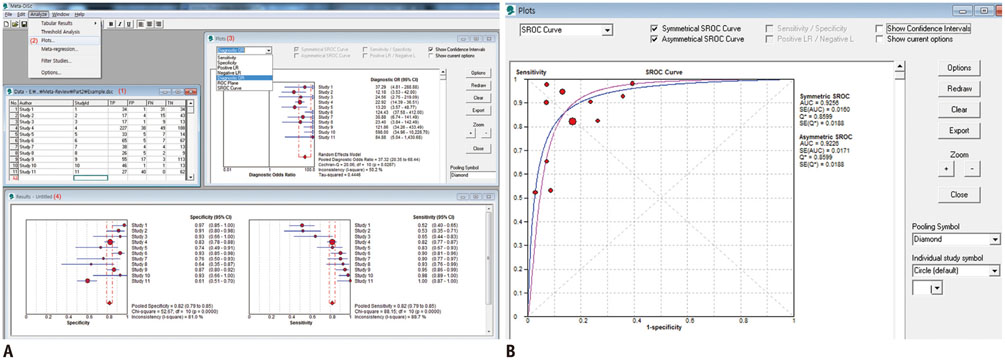
Fig. 1 Examples of forest plot, separate pooling of sensitivity and specificity, and construction of Moses-Littenberg SROC curve (method currently not recommended) using Meta-disc software. A. Use of Meta-disc. First, data are entered in data window (1). In analyze tab, choose Plots function (2). Then, select plot to draw from new pop-up window (3). Results can be reviewed in Results window (4). B. Moses-Littenberg SROC curve. SROC curves and summary estimates, including area under ROC curve (AUC) and Q* index are presented. SROC = summary receiver operating characteristic
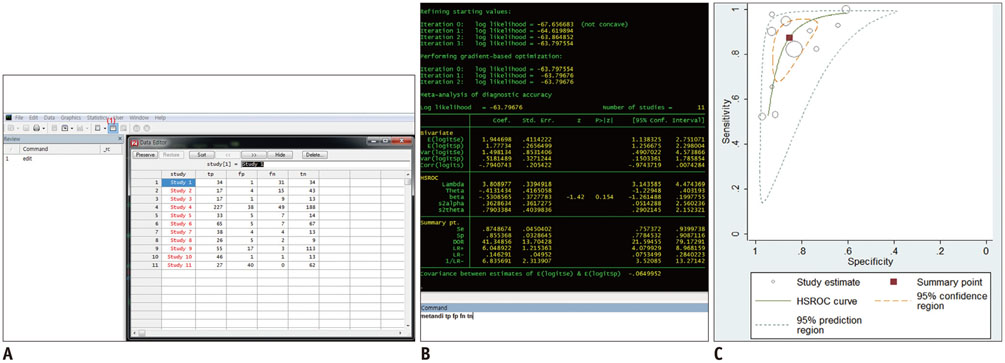
Fig. 2 Example of meta-analysis with hierarchical modeling (method currently recommended). Metandi module in STATA is used. A. Data input. Simply click data editor button (1) and enter data in Data Editor window (2). B. Calculation of summary estimates. Summary estimates of sensitivity, specificity, DOR, LR+, and LR- can be obtained using command "metandi tp fp fn tn". C. HSROC curve is obtained using command "metandiplot tp fp fn tn". Circles represent estimates of individual primary studies, and square indicates summary points of sensitivity and specificity. HSROC curve is plotted as curvilinear line passing through summary point. 95% confidence region and 95% prediction region are also provided. DOR = diagnostic odds ratio, HSROC = hierarchical summary receiver operating characteristic, LR = likelihood ratio
Cited by 4 articles
-
Systematic Review and Meta-Analysis of Studies Evaluating Diagnostic Test Accuracy: A Practical Review for Clinical Researchers-Part I. General Guidance and Tips
Kyung Won Kim, Juneyoung Lee, Sang Hyun Choi, Jimi Huh, Seong Ho Park
Korean J Radiol. 2015;16(6):1175-1187. doi: 10.3348/kjr.2015.16.6.1175.Efficacy and Safety of Microwave Ablation for Malignant Renal Tumors: An Updated Systematic Review and Meta-Analysis of the Literature Since 2012
Sang Hyun Choi, Jong Woo Kim, Jin Hyoung Kim, Kyung Won Kim
Korean J Radiol. 2018;19(5):938-949. doi: 10.3348/kjr.2018.19.5.938.Comparison of Radioembolization and Sorafenib for the Treatment of Hepatocellular Carcinoma with Portal Vein Tumor Thrombosis: A Systematic Review and Meta-Analysis of Safety and Efficacy
Pyeong Hwa Kim, Sang Hyun Choi, Jin Hyoung Kim, Seong Ho Park
Korean J Radiol. 2019;20(3):385-398. doi: 10.3348/kjr.2018.0496.Technical Performance of Two-Dimensional Shear Wave Elastography for Measuring Liver Stiffness: A Systematic Review and Meta-Analysis
Dong Wook Kim, Chong Hyun Suh, Kyung Won Kim, Junhee Pyo, Chan Park, Seung Chai Jung
Korean J Radiol. 2019;20(6):880-893. doi: 10.3348/kjr.2018.0812.
Reference
-
1. Dinnes J, Deeks J, Kirby J, Roderick P. A methodological review of how heterogeneity has been examined in systematic reviews of diagnostic test accuracy. Health Technol Assess. 2005; 9:1–113. iii2. Irwig L, Tosteson AN, Gatsonis C, Lau J, Colditz G, Chalmers TC, et al. Guidelines for meta-analyses evaluating diagnostic tests. Ann Intern Med. 1994; 120:667–676.3. Reitsma JB, Glas AS, Rutjes AW, Scholten RJ, Bossuyt PM, Zwinderman AH. Bivariate analysis of sensitivity and specificity produces informative summary measures in diagnostic reviews. J Clin Epidemiol. 2005; 58:982–990.4. Zamora J, Abraira V, Muriel A, Khan K, Coomarasamy A. Meta-DiSc: a software for meta-analysis of test accuracy data. BMC Med Res Methodol. 2006; 6:31.5. Moses LE, Shapiro D, Littenberg B. Combining independent studies of a diagnostic test into a summary ROC curve: dataanalytic approaches and some additional considerations. Stat Med. 1993; 12:1293–1316.6. Littenberg B, Moses LE. Estimating diagnostic accuracy from multiple conflicting reports: a new meta-analytic method. Med Decis Making. 1993; 13:313–321.7. Rutter CM, Gatsonis CA. A hierarchical regression approach to meta-analysis of diagnostic test accuracy evaluations. Stat Med. 2001; 20:2865–2884.8. Harbord RM, Whiting P, Sterne JA, Egger M, Deeks JJ, Shang A, et al. An empirical comparison of methods for meta-analysis of diagnostic accuracy showed hierarchical models are necessary. J Clin Epidemiol. 2008; 61:1095–1103.9. Kim KW, Lee J, Choi SH, Huh J, Park SH. Systematic review and meta-analysis of studies evaluating diagnostic test accuracy: a practical review for clinical researchers--part i. general guidance and tips. Korean J Radiol. 2015; 16:1175–1118.10. Higgins JP, Thompson SG, Deeks JJ, Altman DG. Measuring inconsistency in meta-analyses. BMJ. 2003; 327:557–560.11. Ochodo EA, Reitsma JB, Bossuyt PM, Leeflang MM. Survey revealed a lack of clarity about recommended methods for meta-analysis of diagnostic accuracy data. J Clin Epidemiol. 2013; 66:1281–1288.12. Devillé WL, Buntinx F, Bouter LM, Montori VM, de Vet HC, van der Windt DA, et al. Conducting systematic reviews of diagnostic studies: didactic guidelines. BMC Med Res Methodol. 2002; 2:9.13. Dodd JD. Evidence-based practice in radiology: steps 3 and 4--appraise and apply diagnostic radiology literature. Radiology. 2007; 242:342–354.14. Leeflang MM, Deeks JJ, Gatsonis C, Bossuyt PM. Cochrane Diagnostic Test Accuracy Working Group. Systematic reviews of diagnostic test accuracy. Ann Intern Med. 2008; 149:889–897.15. Macaskill P, Gatsonis C, Deeks JJ, Harbord RM, Takwoingi Y. Chapter 10: Analysing and Presenting Results. In : Deeks JJ, Bossuyt PM, Gatsonis C, editors. Cochrane Handbook for Systematic Reviews of Diagnostic Test Accuracy Version 1.0. The Cochrane Collaboration, 2010. Available from: http://srdta.cochrane.org/.16. Trikalinos TA, Balion CM, Coleman CI, Griffith L, Santaguida PL, Vandermeer B, et al. Chapter 8: meta-analysis of test performance when there is a "gold standard". J Gen Intern Med. 2012; 27:Suppl 1. S56–S66.17. DerSimonian R, Laird N. Meta-analysis in clinical trials. Control Clin Trials. 1986; 7:177–188.18. Bossuyt P, Davenport C, Deeks J, Hyde C, Leeflang M, Scholten R. Chapter 11: Interpreting results and drawing conclusions. In : Deeks JJ, Bossuyt PM, Gatsonis C, editors. Cochrane handbook for systematic reviews of diagnostic test accuracy version 0.9. The Cochrane Collaboration, 2013. Available from: http://srdta.cochrane.org/.19. Kim KW, Park SH, Pyo J, Yoon SH, Byun JH, Lee MG, et al. Imaging features to distinguish malignant and benign branch-duct type intraductal papillary mucinous neoplasms of the pancreas: a meta-analysis. Ann Surg. 2014; 259:72–81.20. Jones CM, Athanasiou T. Diagnostic accuracy meta-analysis: review of an important tool in radiological research and decision making. Br J Radiol. 2009; 82:441–446.21. Rutter CM, Gatsonis CA. Regression methods for metaanalysis of diagnostic test data. Acad Radiol. 1995; 2:Suppl 1. S48–S56. discussion S65-S67, S70-S71 pas22. Harbord RM, Deeks JJ, Egger M, Whiting P, Sterne JA. A unification of models for meta-analysis of diagnostic accuracy studies. Biostatistics. 2007; 8:239–251.23. Walter SD. Properties of the summary receiver operating characteristic (SROC) curve for diagnostic test data. Stat Med. 2002; 21:1237–1256.24. Harbord RM, Whiting P. Metandi: Meta-analysis of diagnostic accuracy using hierarchical logistic regression. Stata J. 2009; 9:211–229.25. Doebler P, Holling H. Meta-analysis of diagnostic accuracy (mada). Cran.r-project.org Web site. Accessed October 5, 2015. https://cran.r-project.org/web/packages/mada/vignettes/mada.pdf.
- Full Text Links
-
- Actions
-
Cited
- CITED
-
- Close
- Share
-
- Similar articles
-
- Systematic Review and Meta-Analysis of Studies Evaluating Diagnostic Test Accuracy: A Practical Review for Clinical Researchers-Part I. General Guidance and Tips
- Overview of the Process of Conducting Meta-analyses of the Diagnostic Test Accuracy
- Meta-Analysis of Diagnostic Test Accuracy
- An overview of systematic reviews of diagnostic tests accuracy
- Meta-analysis of diagnostic test accuracy studies with multiple thresholds for data integration


