
Hanyang Med Rev.
2016 May;36(2):131-135. 10.7599/hmr.2016.36.2.131.
Microvascular Decompression for Tinnitus
- Affiliations
-
- 1Department of Neurosurgery, Hanyang University College of Medicine, Seoul, Korea. koy8497@hanyang.ac.kr
- KMID: 2164672
- DOI: http://doi.org/10.7599/hmr.2016.36.2.131
Abstract
- Tinnitus had been considered a surgically incurable disease, given the failure of several treatment methods. Jannetta reported that tinnitus is one of the hyperactive diseases of the cranial nerve along with hemifacial spasm and trigeminal neuralgia (TGN). Microvascular decompression (MVD) of the eighth cranial nerve was introduced to treat medically intractable tinnitus. Intraoperative monitoring of brainstem auditory evoked potential (BAEP) was able to reduce postoperative complication rates. Less than 1 ms of latency delay and a 40% decrease in amplitude of wave V of the brainstem evoked potential is a landmark of monitoring during surgery. Less than 6 years of duration of tinnitus, normal BAEP before surgery, no accompanying dizziness before surgery and a loop-type offending artery are effective factors for good surgical results of MVD.
MeSH Terms
Figure
-
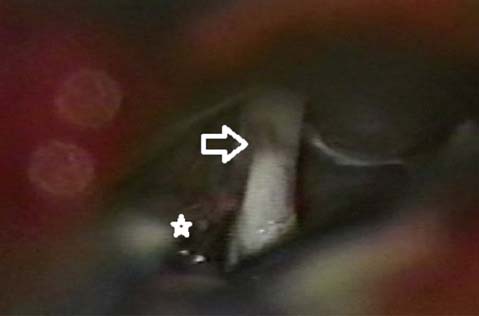
Fig. 1 Intraoperative finding: An artery (asterisk) was displaced from the eighth cranial nerve, which is discolored at the portion (arrow) being compressed by an artery.
Cited by 1 articles
-
Tinnitus: Overview
Chul Won Park
Hanyang Med Rev. 2016;36(2):79-80. doi: 10.7599/hmr.2016.36.2.79.
Reference
-
1. Jannetta PJ. Arterial compression of the trigeminal nerve at the pons in patients with trigeminal neuralgia. J Neurosurg. 1967; 26:159–162.
Article2. Jannetta PJ. Neurovascular compression in cranial nerve and systemic disease. Ann Surg. 1980; 192:518–525.
Article3. Moller MB, Moller AR, Jannetta PJ, Jho HD. Vascular decompression surgery for severe tinnitus: selection criteria and results. Laryngoscope. 1993; 103:421–427.
Article4. Moller AR, Moller MB. Does intraoperative monitoring of auditory evoked potentials reduce incidence of hearing loss as a complication of microvascular decompression of cranial nerve? Neurosurgery. 1989; 24:257–263.5. Ko Y, Park CW. Microvascular decompression for tinnitus. Stereotact Funct Neurosurg. 1997; 68:266–269.
Article6. Howe JF, LoeserJD , Calvin WH. Mechanosensitivity of dorsal root ganglion and chronically injured axons: a physiological basis for the radicular pains of root compression. Pain. 1977; 3:25–41.
Article7. Calvin WH, Loeser JD, Howe JF. A neurophysiological theory for the pain mechanism of tic douloureux. Pain. 1977; 3:147–154.
Article8. Hardy DG, Rhoton AL Jr. Microsurgical relationship of the superior cerebellar artery and the trigeminal nerve. J Neurosurg. 1978; 49:669–678.
Article9. Matsushima T, Inoue T, Fukui M. Arteries in contact with the cisternal portion of the facial nerve in autopsy cases: microsurgical anatomy for neurovascular decompression surgery for hemifacial spasm. Surg Neurol. 1990; 34:87–93.
Article10. Portnoy HD, Chopp M, Branch C, Shannon MB. Cerebrospinal fluid pulse wave form as an indicator of cerebral autoregulation. J Neurosurg. 1982; 56:666–678.
Article11. Moller AR. The cranial nerve vascular compression syndrome: ii. a review of pathophysiology. Acta Neurochir(Wien). 1991; 113:24–30.
Article12. Yap L, Pothula VB, Lesser T. Microvascular decompression of cochleovestibular nerve. Eur Arch Otorhinolaryngol. 2008; 265:861–869.
Article13. Moller MB, Moller AR, Jannetta PJ, Sekhar L. Diagnosis and surgical treatment of disabling positional vertigo. J Neurosurg. 1986; 64:21–28.
Article14. Zhang L, Yu Y, Yuan Y, Xu J, Xu X, Zhang J. Microvascular decompression of cochleovestibular nerve in patients with tinnitus and vertigo. Neurol India. 2012; 60:495–497.
Article15. Brookes GB. Vascular-decompression surgery for severe tinntus. Am J Otol. 1996; 17:569–576.16. Vasama JP, Moller MB, Moller AR. Microvascular decompression of the cochlear nerve in patients with severe tinnitus. Preoperative findings and operative outcome in 22 patients. Neurol Res. 1998; 20:242–248.
Article17. Sohmer H, Feinmesser M. Cochlear action potentials recorded from the external ear in man. Ann Otol Rhinol Laryngol. 1967; 76:427–435.
Article18. Levine RA, Montgomery WW, Ojemann RG, McGaffigan PM. Evoked potential detection of hearing loss during acoustic neuroma surgery. Neurology. 1978; 28:339.19. Leclercq TA, Hill CL, Grisoli F. Retromastoid microsurgical approach to vascular compression of the eight cranial nerve. Laryngoscope. 1980; 90:1011–1017.
Article20. Grundy BL. Monitoring of sensory evoked potentials during neurosurgical operations: methods and applications. Neurosurgery. 1982; 11:556–575.
Article21. Ojemann RG, Levine RA, Montgomery WM, McGaffigan P. Use of intraoperative auditory evoked potentials to preserve hearing in unilateral acoustic neuroma removal. J Neurosurg. 1984; 61:938–948.
Article22. Zappulla R, Greenblatt E, Kaye S, Malis L. A quantitative assessment of the brain stem auditory evoked response during intraoperative monitoring. Neurosurgery. 1984; 15:186–191.
Article23. Raudzens PA, Shetter AG. Intaroperative monitoring of brain stem auditory evoked potentials. J Neurosurg. 1982; 57:341–348.24. Little JR, Lesser RP, Lueders H, Furlan AJ. Brain stem auditory evoked potentials in posterior circulation surgey. Neurosurgery. 1983; 12:496–502.25. Schramm J, Mokrusch T, Fahlbusch R, Hochstetter A. Detailed analysis of intraoperative changes monitoring brain stem auditory evoked potentials. Neurosurgery. 1988; 22:694–702.
Article26. Hatayama T, Moller AR. Correlation between latency and amplitude of peak V in the brainstem auditory evoked potential: intraoperative recordings in microvascular decompression operations. Acta Neurochir. 1998; 140:681–687.
Article
- Full Text Links
-
- Actions
-
Cited
- CITED
-
- Close
- Share
-
- Similar articles
-
- Microvascular triple decompression for combined simultaneous trigeminal neuralgia, hemifacial spasm, and pulsatile tinnitus due to separate offending vessels
- Delayed Progressive Extradural Pneumatocele due to Incomplete Sealing of Opened Mastoid Air Cell after Micro-Vascular Decompression
- Significance of Intraoperative BAEPs Monitoring during Microvascular Decompression Surgery
- Intraoperative monitoring of microvascular decompression in hemifacial spasm
- Reconstruction of the Craniectomy Site with the Bone Chips in Patients with Hemifacial Spasm


