
Restor Dent Endod.
2012 Aug;37(3):130-135. 10.5395/rde.2012.37.3.130.
Power density of various light curing units through resin inlays with modified layer thickness
- Affiliations
-
- 1Department of Conservative Dentistry, Wonkwang University College of Dentistry and Dental Research Institute, Iksan, Korea.
- 2Department of Industrial and Management Engineering, Daejin University, Pochon, Korea.
- 3Department of Conservative Dentistry, Chosun University School of Dentistry, Gwangju, Korea.
- 4Department of Conservative Dentistry, Gangneung-Wonju National University College of Dentistry, Gangneung, Korea.
- 5Department of Conservative Dentistry, Chonnam National University School of Dentistry and Dental Science Research Institute, Gwangju, Korea. conden@jnu.ac.kr
- KMID: 1995651
- DOI: http://doi.org/10.5395/rde.2012.37.3.130
Abstract
OBJECTIVES
The purpose of this study was to enhance curing light penetration through resin inlays by modifying the thicknesses of the dentin, enamel, and translucent layers.
MATERIALS AND METHODS
To investigate the layer dominantly affecting the power density of light curing units, resin wafers of each layer with 0.5 mm thickness were prepared and power density through resin wafers was measured with a dental radiometer (Cure Rite, Kerr). The dentin layer, which had the dominant effect on power density reduction, was decreased in thickness from 0.5 to 0.1 mm while thickness of the enamel layer was kept unchanged at 0.5 mm and thickness of the translucent layer was increased from 0.5 to 0.9 mm and vice versa, in order to maintain the total thickness of 1.5 mm of the resin inlay. Power density of various light curing units through resin inlays was measured.
RESULTS
Power density measured through 0.5 mm resin wafers decreased more significantly with the dentin layer than with the enamel and translucent layers (p < 0.05). Power density through 1.5 mm resin inlays increased when the dentin layer thickness was reduced and the enamel or translucent layer thickness was increased. The highest power density was recorded with dentin layer thickness of 0.1 mm and increased translucent layer thickness in all light curing units.
CONCLUSIONS
To enhance the power density through resin inlays, reducing the dentin layer thickness and increasing the translucent layer thickness would be recommendable when fabricating resin inlays.
Keyword
MeSH Terms
Figure
-
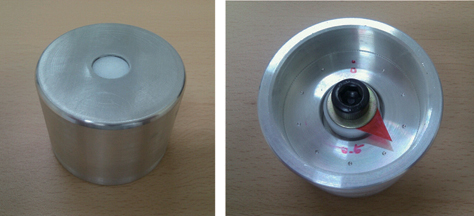
Figure 1 Photograph of the custom-made aluminum mold with a movable Teflon plate attached to a bolt.
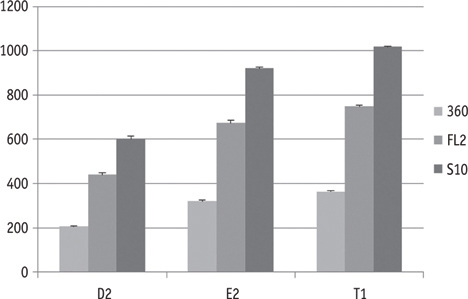
Figure 2 Power densities of light curing units measured through 0.5 mm resin wafers. The power densities through the dentin, enamel, and translucent shades showed statistically significant differences (n = 7, p < 0.001). D2, dentin shade A2; E2, enamel shade E2; T1, translucent shade T1; 360, Optilux 360; FL2, Elipar FreeLight 2; S10, Elipar S10.
Cited by 1 articles
-
Light curing of dual cure resin cement
Hoon-Sang Chang
Restor Dent Endod. 2013;38(4):266-267. doi: 10.5395/rde.2013.38.4.266.
Reference
-
1. Sheth PJ, Jensen ME, Sheth JJ. Comparative evaluation of three resin inlay techniques: microleakage studies. Quintessence Int. 1989. 20:831–836.2. Bausch JR, de Lange K, Davidson CL, Peters A, de Gee AJ. Clinical significance of polymerization shrinkage of composite resins. J Prosthet Dent. 1982. 48:59–67.
Article3. Eick JD, Welch FH. Polymerization shrinkage of posterior composite resins and its possible influence on postoperative sensitivity. Quintessence Int. 1986. 17:103–111.4. Robinson PB, Moore BK, Swartz ML. Comparison of microleakage in direct and indirect composite resin restorations in vitro. Oper Dent. 1987. 12:113–116.5. Roberson TM, Heymann HO, Swift EJ. Sturdevant's art & science of operative dentistry. 2002. 4th ed. St. Louis: Mosby Inc.;580.6. el-Mowafy O. The use of resin cements in restorative dentistry to overcome retention problems. J Can Dent Assoc. 2001. 67:97–102.7. Sorensen JA, Kang SK, Avera SP. Porcelain-composite interface microleakage with various porcelain surface treatments. Dent Mater. 1991. 7:118–123.
Article8. Jensen ME, Sheth JJ, Tolliver D. Etched-porcelain resin-bonded full-veneer crowns: in vitro fracture resistance. Compendium. 1989. 10:336–338. 340–341. 344–347.9. Krämer N, Lohbauer U, Frankenberger R. Adhesive luting of indirect restorations. Am J Dent. 2000. 13(Spec No):60D–76D.10. el-Badrawy WA, el-Mowafy OM. Chemical versus dual curing of resin inlay cements. J Prosthet Dent. 1995. 73:515–524.
Article11. Hasegawa EA, Boyer DB, Chan DC. Hardening of dual-cured cements under composite resin inlays. J Prosthet Dent. 1991. 66:187–192.
Article12. Chan KC, Boyer DB. Curing light-activated composite cement through porcelain. J Dent Res. 1989. 68:476–480.
Article13. Rasetto FH, Driscoll CF, von Fraunhofer JA. Effect of light source and time on the polymerization of resin cement through ceramic veneers. J Prosthodont. 2001. 10:133–139.
Article14. Rueggeberg FA, Jordan DM. Effect of light-tip distance on polymerization of resin composite. Int J Prosthodont. 1993. 6:364–370.15. Chang HS, Lee SR, Hong SO, Ryu HW, Song CK, Min KS. Effect of infection control barrier thickness on light curing units. J Korean Acad Conserv Dent. 2010. 35:368–373.
Article16. Blackman R, Barghi N, Duke E. Influence of ceramic thickness on the polymerization of light-cured resin cement. J Prosthet Dent. 1990. 63:295–300.
Article17. Prati C, Chersoni S, Montebugnoli L, Montanari G. Effect of air, dentin and resin-based composite thickness on light intensity reduction. Am J Dent. 1999. 12:231–234.18. dos Santos GB, Alto RV, Filho HR, da Silva EM, Fellows CE. Light transmission on dental resin composites. Dent Mater. 2008. 24:571–576.
Article19. Kim SS, Cho SS, Um CM. The microhardness and the degree of conversion of light cured composite resin and dual cured resin cements under porcelain inlay. J Korean Acad Conserv Dent. 2000. 25:17–40.20. Chang HS, Lim YJ, Kim JM, Hong SO. Power density of light curing units through resin inlays fabricated with direct and indirect composites. J Korean Acad Conserv Dent. 2010. 35:353–358.
Article21. Taira M, Okazaki M, Takahashi J. Studies on optical properties of two commercial visible-light-cured composite resins by diffuse reflectance measurements. J Oral Rehabil. 1999. 26:329–337.
Article22. Chang HS. Infection control of light curing units. J Korean Acad Conserv Dent. 2010. 35:235–237.
Article23. Rueggeberg FA, Caughman WF, Curtis JW Jr. Effect of light intensity and exposure duration on cure of resin composite. Oper Dent. 1994. 19:26–32.24. Hofmann N, Hugo B, Klaiber B. Effect of irradiation type (LED or QTH) on photo-activated composite shrinkage strain kinetics, temperature rise, and hardness. Eur J Oral Sci. 2002. 110:471–479.
Article
- Full Text Links
-
- Actions
-
Cited
- CITED
-
- Close
- Share
-
- Similar articles
-
- Power density of light curing units through resin inlays fabricated with direct and indirect composites
- Effect of infection control barrier thickness on light curing units
- Comparison of light transmittance in different thicknesses of zirconia under various light curing units
- Evaluation of High-power Light Emitting Diode Curing Light on Sealant Polymerization
- Comparison of the degree of conversion of light-cured resin cement in regard to porcelain laminate thickness, light source and curing time using FT-IR


