
J Adv Prosthodont.
2010 Mar;2(1):4-6. 10.4047/jap.2010.2.1.4.
Trend analysis of prosthodontic treatment modality between 2005 and 2008 in Seoul National University Dental Hospital
- Affiliations
-
- 1Department of Stomatology, the General Hospital of Chinese People's Liberation Army, Beijing, China.
- 2Department of Prosthodontics, School of Dentistry, Seoul National University, Seoul, Korea. heosj@plaza.snu.ac.kr
- KMID: 1975170
- DOI: http://doi.org/10.4047/jap.2010.2.1.4
Abstract
- PURPOSE
The aim of this article is to analyze the preference for treatment modality of dentists. MATERIAL AND METHODS: Data of 20,038 patients was involved. Data analysis were done by distribution according to the various kinds of prosthesis, including complete denture, removable partial denture, fixed partial denture, implant-supported dental prosthesis as well as distribution according to the professional titles of the dentists finishing the treatment, including resident and professors.
RESULTS
The number of cases of dental prosthesis increased year by year. 61.06% of the patients accepted fixed partial denture restoration. The number of patients who accepted implant supported restoration is also increasing year by year. The number of complete denture, implant-supported dental prosthesis finished by professors was larger than that done by residents, while it was contrary for removable partial denture, fixed partial denture, and the difference was statistically significant (P<.05).
CONCLUSION
Professors and residents have some difference in the categorization of prosthesis finished. Fixed partial denture and implant-supported dental prosthesis are preferred.
MeSH Terms
Figure
-
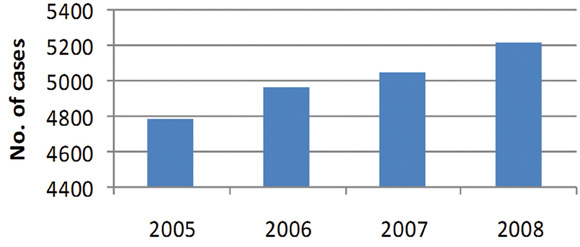
Fig. 1 The number of cases for the department of prosthodontics from 2005 to 2008.
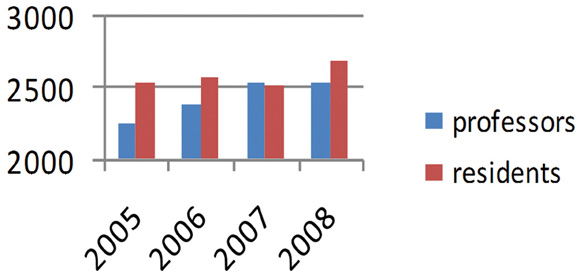
Fig. 2 The numbers of patients finished by professors and residents.
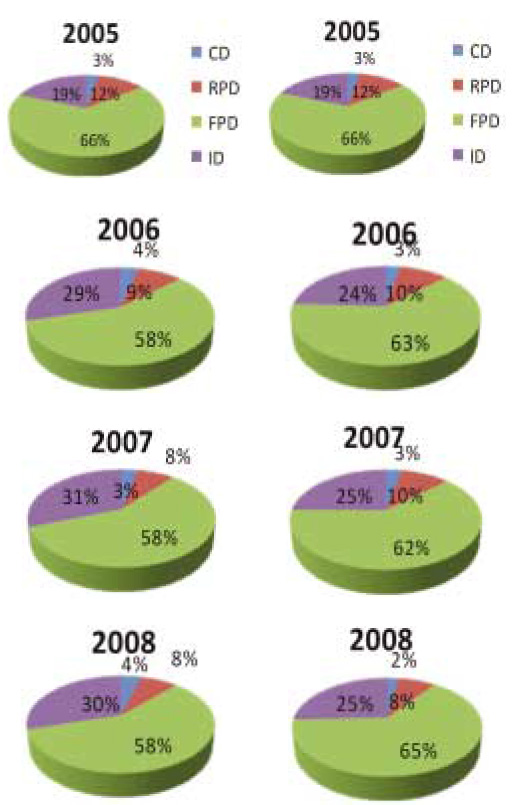
Fig. 3 The percentages for CD, RPD, FPD, and ID finished by professors (left) and residents (right).
Reference
-
1. Celebic A, Knezovic Zlataric D. A comparison of patient's satisfaction between complete and partial removable denture wearers. J Dent. 2003. 31:445–451.2. Heo YY, Heo SJ, Chang MW, Park JM. The patients' satisfaction following implant treatment. J Korean Acad Prosthodont. 2008. 46:569–576.3. Brennan DS, Spencer AJ. Dentist preferences for patients: dimensions and associations with provider, practice, and service characteristics. Int J Behav Med. 2006. 13:69–78.
- Full Text Links
-
- Actions
-
Cited
- CITED
-
- Close
- Share
-
- Similar articles
-
- The study of awareness and practice of infection control on dental practitioners during the prosthodontic treatment
- Influence of implant misplacement on the success of the final prosthesis: Subjective evaluation by a prosthodontist of dental implants placed by an oral and maxillofacial surgeon
- Prosthodontic problems and complications associated with osseointegration
- Occupational health hazards in a prosthodontic practice: review of risk factors and management strategies
- The dentists' perceptions and current prosthodontic treatment status for the disabled in Korea


