J Korean Med Assoc.
2015 Feb;58(2):141-146. 10.5124/jkma.2015.58.2.141.
Use of robots in rehabilitative treatment

- Affiliations
-
- 1Department of Physical Medicine and Rehabilitation, Asan Medical Center, University of Ulsan Colleghe of Medicine, Seoul, Korea. mhchun0@gmail.com
- KMID: 1958376
- DOI: http://doi.org/10.5124/jkma.2015.58.2.141
Abstract
- Recently, rehabilitation robotics technology has advanced, and several therapeutic robots have been developed. Robot-assisted rehabilitation therapy has a number of advantages over manual physical therapy. It can relieve the physical therapist from the strenuous task of manual assistance and provide high-dosage and high-intensity training. Therapeutic rehabilitation robots include end-effector and exoskeleton types, which are mainly applied for rehabilitation of upper extremity motor dysfunction or gait disturbance. In addition, they are used for patients with stroke, traumatic brain injury, spinal cord injury, parkinsonism, and cerebral palsy. Several studies have reported that robot-assisted therapy has a beneficial effect on motor function in patients with impaired motor function, either alone or as an additional therapeutic tool in combination with conventional rehabilitation therapy. We believe that ongoing improvement in robotic technology will help to overcome the disadvantages of conventional rehabilitation therapy and to optimize rehabilitation therapies for disabled patients.
Keyword
MeSH Terms
Figure
-
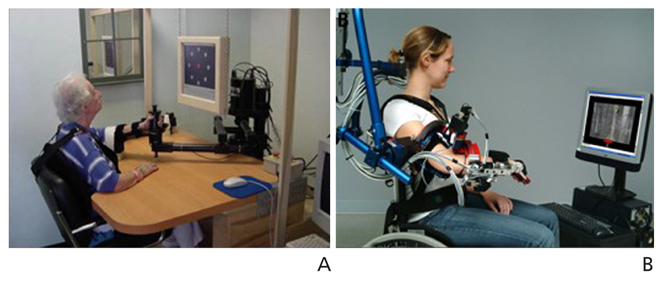
Figure 1 Robot assisted upper limb training using (A) MIT MANUS and (B) ARMin (From Krebs HI, et al. J Neuroeng Rehabil 2004;1:5, according to the Creative Commons license) [6].
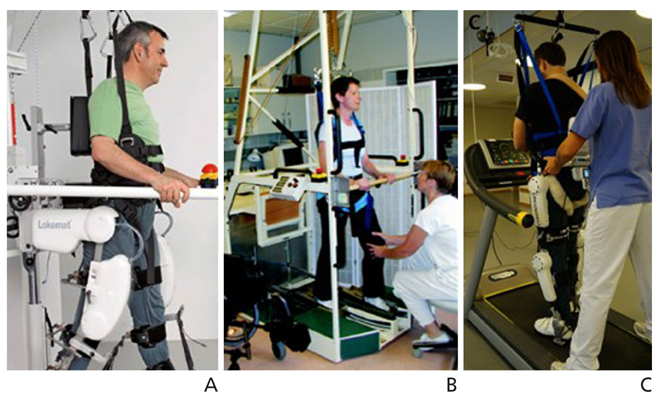
Figure 2 Robot assisted gait training using (A) Lokomat (From Schuck A, et al. J Neuroeng Rehabil 2012;9:31, according to the Creative Commons license) [11], (B) Gait Trainer GT1 (From Werner C, et al. Stroke 2002;33:2895-2901, according to the Creative Commons license) [12], and (C) hybrid assistive limb (From Nilsson A, et al. J Neuroeng Rehabil 2014;11:92, according to the Creative Commons license) [13].
Reference
-
1. Hong KS, Bang OY, Kang DW, Yu KH, Bae HJ, Lee JS, Heo JH, Kwon SU, Oh CW, Lee BC, Kim JS, Yoon BW. Stroke statistics in Korea: part I. Epidemiology and risk factors: a report from the Korean stroke society and clinical research center for stroke. J Stroke. 2013; 15:2–20.
Article2. Esquenazi A, Packel A. Robotic-assisted gait training and restoration. Am J Phys Med Rehabil. 2012; 91:S217–S227.
Article3. Chun MH, Yi JH. Robotics in rehabilitation for patients with brain disease. J Korean Med Assoc. 2013; 56:23–29.
Article4. Lum PS, Godfrey SB, Brokaw EB, Holley RJ, Nichols D. Robotic approaches for rehabilitation of hand function after stroke. Am J Phys Med Rehabil. 2012; 91:S242–S254.
Article5. Lo HS, Xie SQ. Exoskeleton robots for upper-limb rehabilitation: state of the art and future prospects. Med Eng Phys. 2012; 34:261–268.
Article6. Krebs HI, Ferraro M, Buerger SP, Newbery MJ, Makiyama A, Sandmann M, Lynch D, Volpe BT, Hogan N. Rehabilitation robotics: pilot trial of a spatial extension for MIT-Manus. J Neuroeng Rehabil. 2004; 1:5.7. Loureiro RC, Harwin WS, Nagai K, Johnson M. Advances in upper limb stroke rehabilitation: a technology push. Med Biol Eng Comput. 2011; 49:1103–1118.
Article8. Takahashi CD, Der-Yeghiaian L, Le V, Motiwala RR, Cramer SC. Robot-based hand motor therapy after stroke. Brain. 2008; 131:425–437.
Article9. Park JH. Effect of robot-assisted hand rehabilitation on hand function in chronic stroke patients. J Korea Robot Soc. 2013; 8:273–282.
Article10. Jang SH. The recovery of walking in stroke patients: a review. Int J Rehabil Res. 2010; 33:285–289.
Article11. Schuck A, Labruyere R, Vallery H, Riener R, Duschau-Wicke A. Feasibility and effects of patient-cooperative robot-aided gait training applied in a 4-week pilot trial. J Neuroeng Rehabil. 2012; 9:31.12. Werner C, Von Frankenberg S, Treig T, Konrad M, Hesse S. Treadmill training with partial body weight support and an electromechanical gait trainer for restoration of gait in subacute stroke patients: a randomized crossover study. Stroke. 2002; 33:2895–2901.
Article13. Nilsson A, Vreede KS, Haglund V, Kawamoto H, Sankai Y, Borg J. Gait training early after stroke with a new exoskeleton: the hybrid assistive limb: a study of safety and feasibility. J Neuroeng Rehabil. 2014; 11:92.
Article14. Barker-Collo S, Feigin VL, Parag V, Lawes CM, Senior H. Auckland Stroke Outcomes Study. Part 2: Cognition and functional outcomes 5 years poststroke. Neurology. 2010; 75:1608–1616.
Article15. Mehrholz J, Hadrich A, Platz T, Kugler J, Pohl M. Electromechanical and robot-assisted arm training for improving generic activities of daily living, arm function, and arm muscle strength after stroke. Cochrane Database Syst Rev. 2012; 6:CD006876.
Article16. Lo AC, Guarino PD, Richards LG, Haselkorn JK, Wittenberg GF, Federman DG, Ringer RJ, Wagner TH, Krebs HI, Volpe BT, Bever CT Jr, Bravata DM, Duncan PW, Corn BH, Maffucci AD, Nadeau SE, Conroy SS, Powell JM, Huang GD, Peduzzi P. Robot-assisted therapy for long-term upper-limb impairment after stroke. N Engl J Med. 2010; 362:1772–1783.
Article17. Schwartz I, Sajin A, Fisher I, Neeb M, Shochina M, Katz-Leurer M, Meiner Z. The effectiveness of locomotor therapy using robotic-assisted gait training in subacute stroke patients: a randomized controlled trial. PM R. 2009; 1:516–523.
Article18. Swinnen E, Beckwee D, Meeusen R, Baeyens JP, Kerckhofs E. Does robot-assisted gait rehabilitation improve balance in stroke patients? A systematic review. Top Stroke Rehabil. 2014; 21:87–100.
Article19. Dias D, Lains J, Pereira A, Nunes R, Caldas J, Amaral C, Pires S, Costa A, Alves P, Moreira M, Garrido N, Loureiro L. Can we improve gait skills in chronic hemiplegics? A randomised control trial with gait trainer. Eura Medicophys. 2007; 43:499–504.20. Peurala SH, Tarkka IM, Pitkänen K, Sivenius J. The effectiveness of body weight-supported gait training and floor walking in patients with chronic stroke. Arch Phys Med Rehabil. 2005; 86:1557–1564.
Article21. Hsieh YW, Wu CY, Lin KC, Yao G, Wu KY, Chang YJ. Dose-response relationship of robot-assisted stroke motor rehabilitation: the impact of initial motor status. Stroke. 2012; 43:2729–2734.
Article22. Cortes M, Elder J, Rykman A, Murray L, Avedissian M, Stampa A, Thickbroom GW, Pascual-Leone A, Krebs HI, Valls-Sole J, Edwards DJ. Improved motor performance in chronic spinal cord injury following upper-limb robotic training. NeuroRehabilitation. 2013; 33:57–65.
Article23. Del-Ama AJ, Gil-Agudo A, Pons JL, Moreno JC. Hybrid gait training with an overground robot for people with incomplete spinal cord injury: a pilot study. Front Hum Neurosci. 2014; 8:298.
Article24. Hoekstra F, van Nunen MP, Gerrits KH, Stolwijk-Swuste JM, Crins MH, Janssen TW. Effect of robotic gait training on cardiorespiratory system in incomplete spinal cord injury. J Rehabil Res Dev. 2013; 50:1411–1422.
Article25. Labruyere R, van Hedel HJ. Strength training versus robot-assisted gait training after incomplete spinal cord injury: a randomized pilot study in patients depending on walking assistance. J Neuroeng Rehabil. 2014; 11:4.
Article26. Picelli A, Melotti C, Origano F, Neri R, Waldner A, Smania N. Robot-assisted gait training versus equal intensity treadmill training in patients with mild to moderate Parkinson's disease: a randomized controlled trial. Parkinsonism Relat Disord. 2013; 19:605–610.
Article27. Picelli A, Melotti C, Origano F, Waldner A, Gimigliano R, Smania N. Does robotic gait training improve balance in Parkinson's disease? A randomized controlled trial. Parkinsonism Relat Disord. 2012; 18:990–993.
Article28. Gilliaux M, Renders A, Dispa D, Holvoet D, Sapin J, Dehez B, Detrembleur C, Lejeune TM, Stoquart G. Upper limb robot-assisted therapy in cerebral palsy: a single-blind randomized controlled trial. Neurorehabil Neural Repair. 2015; 29:183–192.29. Fluet GG, Qiu Q, Kelly D, Parikh HD, Ramirez D, Saleh S, Adamovich SV. Interfacing a haptic robotic system with complex virtual environments to treat impaired upper extremity motor function in children with cerebral palsy. Dev Neurorehabil. 2010; 13:335–345.
Article30. Meyer-Heim A, van Hedel HJ. Robot-assisted and computer-enhanced therapies for children with cerebral palsy: current state and clinical implementation. Semin Pediatr Neurol. 2013; 20:139–145.
Article
- Full Text Links
-
- Actions
-
Cited
- CITED
-
- Close
- Share
-
- Similar articles
-
- The Survey of Recognition about Rehabilitative Robots for Treatmentin Physical Therapists
- Clinical Use of Robots as a Part of Rehabilitation Medicine
- Role of computers and robots in future otological surgery
- Spinal Mobility and Radiologic Change after Comprehensive Rehabilitative Management of Ankylosing Spondylitis
- Application of robots in general surgery