
J Korean Acad Nurs.
2013 Jun;43(3):420-430. 10.4040/jkan.2013.43.3.420.
Effect of Kegel Exercise to Prevent Urinary and Fecal Incontinence in Antenatal and Postnatal Women: Systematic Review
- Affiliations
-
- 1School of Nursing, Pai Chai University, Daejeon, Korea. shpark@pcu.ac.kr
- 2Research Development Team, Korea Health Promotion Foundation, Seoul, Korea.
- 3Office of Quality Improvement, Severance Hospital, Yonsei University Health System, Seoul, Korea.
- 4Health Insurance Review and Assessment Service, Seoul, Korea.
- KMID: 1707132
- DOI: http://doi.org/10.4040/jkan.2013.43.3.420
Abstract
- PURPOSE
The aim of this study was to review the literature to determine whether intensive pelvic floor muscle training during pregnancy and after delivery could prevent urinary and fecal incontinence.
METHODS
Randomized controlled trials (RCT) of low-risk obstetric populations who had done Kegel exercise during pregnancy and after delivery met the inclusion criteria. Articles published between 1966 and 2012 from periodicals indexed in Ovid Medline, Embase, Scopus, KoreaMed, NDSL and other databases were selected, using the following keywords: 'Kegel, pelvic floor exercise'. The Cochrane's Risk of Bias was applied to assess the internal validity of the RCT. Fourteen selected studies were analyzed by meta-analysis using RevMan 5.1.
RESULTS
Fourteen RCTs with high methodological quality, involving 6,454 women were included. They indicated that Kegel exercise significantly reduced the development of urinary and fecal incontinence from pregnancy to postpartum. Also, there was low clinical heterogeneity.
CONCLUSION
There is some evidence that for antenatal and postnatal women, Kegel exercise can prevent urinary and fecal incontinence. Therefore, a priority task is to develop standardized Kegel exercise programs for Korean pregnant and postpartum women and make efficient use of these programs.
MeSH Terms
Figure
-

Figure 1 Flow diagram of article selection.
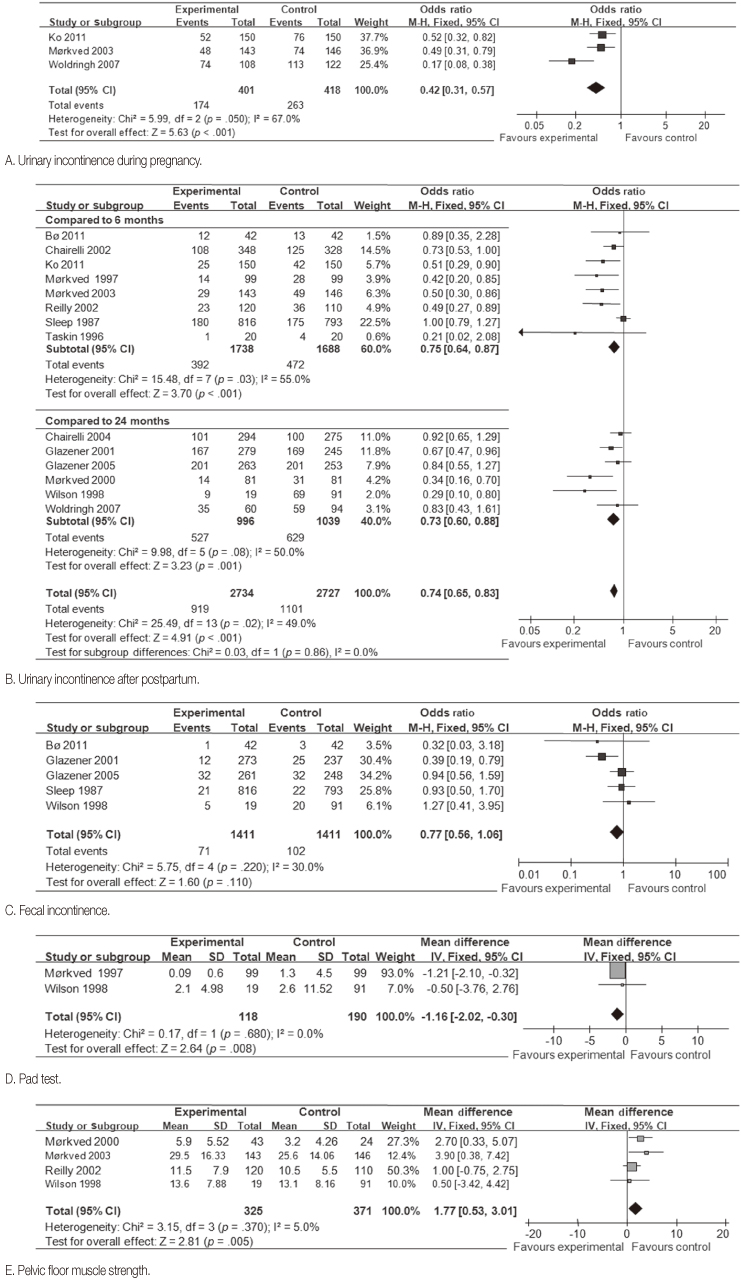
Figure 2 Comparison outcomes of Kegel exercise versus control.
Cited by 1 articles
-
A Study on Fecal Incontinence and Depression of Rural Women
Chunmi Kim, Hung Sa Lee, Eun Man Kim
J Korean Acad Community Health Nurs. 2014;25(3):198-206. doi: 10.12799/jkachn.2014.25.3.198.
Reference
-
1. Bø K, Haakstad LA. Is pelvic floor muscle training effective when taught in a general fitness class in pregnancy? A randomised controlled trial. Physiotherapy. 2011; 97(3):190–195. http://dx.doi.org/10.1016/j.physio.2010.08.014.2. Boyle R, Hay-Smith EJ, Cody JD, Møkved S. Pelvic floor muscle training for prevention and treatment of urinary and faecal incontinence in antenatal and postnatal women. Cochrane Database Syst Rev. 2012; 10:CD007471. http://dx.doi.org/10.1002/14651858.CD007471.pub2.3. Chiarelli P, Cockburn J. Promoting urinary continence in women after delivery: Randomised controlled trial. BMJ. 2002; 324(7348):1241.4. Chiarelli P, Murphy B, Cockburn J. Promoting urinary continence in postpartum women: 12-month follow-up data from a randomised controlled trial. Int Urogynecol J Pelvic Floor Dysfunct. 2004; 15(2):99–105. discussion 105. http://dx.doi.org/10.1007/s00192-004-1119-y.5. Choi JB. Urinary incontinence in women. Korean J Fam Med. 2010; 31(9):661–671. http://dx.doi.org/10.4082/kjfm.2010.31.9.661.6. Choi MH, Kim HK, Kim TE, Lee JY, Chung DY, Shin JI, et al. The effects of pregnancy and delivery on stress urinary incontinence. Korean J Obstet Gynecol. 1995; 38(9):1572–1576.7. Glazener CM, Herbison GP, MacArthur C, Grant A, Wilson PD. Randomised controlled trial of conservative management of postnatal urinary and faecal incontinence: Six year follow up. BMJ. 2005; 330(7487):337. http://dx.doi.org/10.1136/bmj.38320.613461.82.8. Glazener CM, Herbison GP, Wilson PD, MacArthur C, Lang GD, Gee H, et al. Conservative management of persistent postnatal urinary and faecal incontinence: Randomised controlled trial. BMJ. 2001; 323(7313):593–596.9. Hay-Smith EJ, Bo Berghmans LC, Hendriks HJ, de Bie RA, van Waalwijk van Doorn ES. Pelvic floor muscle training for urinary incontinence in women. Cochrane Database Syst Rev. 2001; (1):CD001407. http://dx.doi.org/10.1002/14651858.cd001407.10. Higgins JPT, Green S. Cochrane handbook for systematic reviews of interventions version 5.1.0. The Cochrane Collaboration. 2011. updated March 2011. Retrieved March 30, 2011. from www.cochrane-handbook.org.11. Hong JY. The efficacy of pelvic floor muscle exercise in patients with genuine stress incontinence. Korean J Urol. 1997; 38(6):639–643.12. Hwang JS, Park TH, Kim DK, Kang MA, Kim SM, Bae CS, et al. The prevalence of female urinary and fecal incontinence. Korean J Obstet Gynecol. 1998; 41(6):1552–1559.13. Jeong NO. Effects of an incontinence prevention program on postpartum women. Korean J Women Health Nurs. 2009; 15(3):177–185. http://dx.doi.org/10.4069/kjwhn.2009.15.3.177.14. Kim KS, Suh MJ. A study on prevalence and its relating factors of urinary incontinence in women. J Korean Acad Fundam Nurs. 1997; 4(1):73–85.15. Kim SY, Park JS. The effect of pelvic muscle exercise program on women with stress urinary incontinence in the degree and amount of urinary incontinence and maximum vaginal contraction pressure. J Korean Acad Adult Nurs. 2000; 12(2):267–277.16. Ko PC, Liang CC, Chang SD, Lee JT, Chao AS, Cheng PJ. A randomized controlled trial of antenatal pelvic floor exercises to prevent and treat urinary incontinence. Int Urogynecol J. 2011; 22(1):17–22. http://dx.doi.org/10.1007/s00192-010-1248-4.17. Lee KS, Lee YS. Pharmacological therapy for urinary incontinence. J Korean Med Assoc. 2007; 50(11):1025–1036. http://dx.doi.org/10.5124/jkma.2007.50.11.1025.18. Lemos A, de Souza AI, Ferreira AL, Figueiroa JN, Cabral-Filho JE. Do perineal exercises during pregnancy prevent the development of urinary incontinence? A systematic review. Int J Urol. 2008; 15(10):875–880. http://dx.doi.org/10.1111/j.1442-2042.2008.02145.x.19. Møkved S, Bø K. The effect of postpartum pelvic floor muscle exercise in the prevention and treatment of urinary incontinence. Int Urogynecol J Pelvic Floor Dysfunct. 1997; 8(4):217–222.20. Møkved S, Bø K. Effect of postpartum pelvic floor muscle training in prevention and treatment of urinary incontinence: A one-year follow up. BJOG. 2000; 107(8):1022–1028.21. Møkved S, Bø K, Schei B, Salvesen KA. Pelvic floor muscle training during pregnancy to prevent urinary incontinence: A single-blind randomized controlled trial. Obstet Gynecol. 2003; 101(2):313–319.22. Moher D, Liberati A, Tetzlaff J, Altman DG. Preferred reporting items for systematic reviews and meta-analyses: The PRISMA statement. Ann Intern Med. 2009; 151(4):264–269. W264.23. Mon YJ, Lim HS, Jung JE, Cho HH, Kim MR, Lew YO, et al. The effects of the number of normal vaginal deliveries to the function of low urogenital system. Korean J Obstet Gynecol. 2007; 50(4):638–644.24. Reilly ET, Freeman RM, Waterfield MR, Waterfield AE, Steggles P, Pedlar F. Prevention of postpartum stress incontinence in primigravidae with increased bladder neck mobility: A randomised controlled trial of antenatal pelvic floor exercises. BJOG. 2002; 109(1):68–76.25. Sampselle CM. Behavioral intervention for urinary incontinence in women: Evidence for practice. J Midwifery Womens Health. 2000; 45(2):94–103.26. Sleep J, Grant A. Pelvic floor exercises in postnatal care. Midwifery. 1987; 3(4):158–164.27. Taskin O, Wheeler JM, Yalcinoglu AI, Coksenim S. The effects of episiotomy and kegel exercises on postpartum pelvic relaxation: A prospective controlled study. J Gynecol Surg. 1996; 12(2):123–127.28. Thomason AD, Miller JM, Delancey JO. Urinary incontinence symptoms during and after pregnancy in continent and incontinent primiparas. Int Urogynecol J Pelvic Floor Dysfunct. 2007; 18(2):147–151. http://dx.doi.org/10.1007/s00192-006-0124-8.29. Wall LL, Davidson TG. The role of muscular re-education by physical therapy in the treatment of genuine stress urinary incontinence. Obstet Gynecol Surv. 1992; 47(5):322–331.30. Wilson PD, Herbison GP. A randomized controlled trial of aelvic floor muscle exercise sto treat, postnatal urinary incontinence. Int Urogynecol J Pelvic Floor Dysfunct. 1998; 9(5):257–264.31. Woldringh C, van den Wijngaart M, Albers-Heitner P, Lycklama à Nijeholt AA, Lagro-Janssen T. Pelvic floor muscle training is not effective in women with UI in pregnancy: A randomised controlled trial. Int Urogynecol J Pelvic Floor Dysfunct. 2007; 18(4):383–390. http://dx.doi.org/10.1007/s00192-006-0175-x.32. Yoo EH. Pelvic floor muscle rehabilitation. Korean J Obstet Gynecol. 2006; 49(9):1838–1843.33. Yoo YJ, Lee EJ. A study on the nursing needs and satosfactions of early postpartum women. J Korean Acad Womens Health Nurs. 1999; 5(3):389–409.
- Full Text Links
-
- Actions
-
Cited
- CITED
-
- Close
- Share
-
- Similar articles
-
- Effect of Kegel Exercise on Urinary Incontinence after Radical Prostatectomy: Systematic Review of Randomized Controlled Trials
- Effect of Pelvic Floor Muscle Exercise for the Older Women with Stress Incontinence
- The Effect of Pelvic Muscle Exercise Program on Women with Stress Urinary Incontinence in the Degree and Amount of Urinary Incontinence and Maximum Vaginal Contraction Pressure
- A Study on Fecal Incontinence and Depression of Rural Women
- Prevalence of the Urinary and Fecal Symptoms in Women with Pelvic Organ Prolapse


