
A Structural Model for Quality of Life of Infertile Women
- Affiliations
-
- 1Department of Nursing, Dankook University, Cheonan, Korea.
- 2College of Nursing Science, Kyung Hee University, Seoul, Korea. suksh@khu.ac.kr
- KMID: 1707121
- DOI: http://doi.org/10.4040/jkan.2013.43.3.312
Abstract
- PURPOSE
The purpose of this study was to test a model for quality of life among infertile women. This model was based primarily on the concept of the Fertility Quality of Life by Boivin et al. (2011) and the Infertility Resilience Model by Rindenour (2009).
METHODS
Fifteen measurable variables were used to estimate quality of life. They included endogenous variables such as fertility quality of life and resilience, and exogenous variables such as infertility related stress, depression, marital adjustment, and family support. Data sets (n=203) used for analysis were collected in a general hospital which had, on average, 400 assisted reproductive technologies per month.
RESULTS
The assessment of the modified model indicated acceptable fit, with chi2/d.f=2.07, GFI=.90, AGFI=.89, NFI=.89, CFI=.91, RMSEA=.07. Depression, infertility related stress, marital adjustment, resilience, and family support had direct influences on quality of life.
CONCLUSION
The results of this study should contribute to the development of nursing intervention programs to enhance quality of life using factors that affect fertiQol (fertility quality of life) of infertile women.
Keyword
MeSH Terms
Figure
-
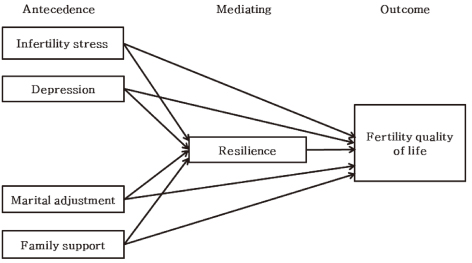
Figure 1 Theoretical framework.
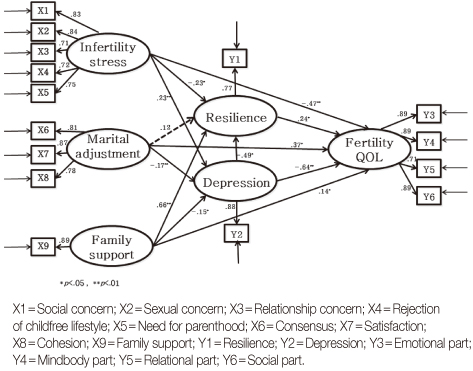
Figure 2 Path diagram for the modified model.
Cited by 13 articles
-
Nursing needs assessment scale for women with infertility: development and validation
Jummi Park, Nayeon Shin, Kyungmi Lee
Korean J Women Health Nurs. 2020;26(2):141-150. doi: 10.4069/kjwhn.2020.03.31.1.
Hye Shin Lee, Sunjoo Boo, Jeong-Ah Ahn, Ju-Eun Song
. ;:.Factors influencing infertility-related quality of life in infertile women
Yun Mi Kim, Ju-Hee Nho
Korean J Women Health Nurs. 2020;26(1):49-60. doi: 10.4069/kjwhn.2020.03.08.Effects of uncertainty and spousal support on infertility-related quality of life in women undergoing assisted reproductive technologies
Hye Shin Lee, Sunjoo Boo, Jeong-Ah Ahn, Ju-Eun Song
Korean J Women Health Nurs. 2020;26(1):72-83. doi: 10.4069/kjwhn.2020.03.15.Factors Affecting the Infertility-Related Quality of Life among the Infertility Women
Young Hee Lee, Jung Suk Park
J Korean Soc Matern Child Health. 2019;23(3):191-201. doi: 10.21896/jksmch.2019.23.3.191.Effects of Irrational Parenthood Cognition, Post Traumatic Stress Disorder and Spousal Support on Quality of Life of Infertile Women
So Ra Yang, Jung Hee Yeo
Korean J Women Health Nurs. 2017;23(2):145-153. doi: 10.4069/kjwhn.2017.23.2.145.Factors Influencing Infertility-related Quality of Life in Women Undergoing Assisted Reproductive Techniques: Focusing on Depression and Resilience
You Jung Jung, Hye Young Kim
Korean J Women Health Nurs. 2017;23(2):117-125. doi: 10.4069/kjwhn.2017.23.2.117.A Phenomenological Study on the Spontaneous Abortion Experiences of Women
Ju-Eun Hong, Jum-Mi Park
Korean J Women Health Nurs. 2017;23(2):63-77. doi: 10.4069/kjwhn.2017.23.2.63.Effects of Irrational Parenthood Cognition, Family Support, and Resilience on Depression of Infertile Women
Eun Young Cho, Mi-Hae Sung
Korean J Women Health Nurs. 2019;25(1):60-72. doi: 10.4069/kjwhn.2019.25.1.60.Factors Influencing the Depression Level of Couples Participating in the National Supporting Program for Infertile Couples
Nami Hwang, Insun Jang
J Korean Acad Community Health Nurs. 2015;26(3):179-189. doi: 10.12799/jkachn.2015.26.3.179.The Study of Relationship among Infertility Stress, Gratitude, and Couple Relationship Changes of Women Undergoing Reproductive Treatments
Miok Kim, Jummi Park, Ju-Eun Hong, Minkyung Ban
J Korean Soc Matern Child Health. 2021;25(3):169-176. doi: 10.21896/jksmch.2021.25.3.169.A Scoping Review of the Effect of the COVID-19 Pandemic on Patients Under Infertility Treatment
Boyoung Jeon, Hongbi Kim, Hye In Jeong
J Korean Soc Matern Child Health. 2023;27(2):80-91. doi: 10.21896/jksmch.2023.27.2.80.
Reference
-
1. Aarts JW, van Empel IW, Boivin J, Nelen WL, Kremer JA, Verhaak CM. Relationship between quality of life and distress in infertility: A validation study of the Dutch FertiQoL. Hum Reprod. 2011; 26(5):1112–1118. http://dx.doi.org/10.1093/humrep/der051.2. Beck AT. Depression: Clinical, experimental, and theoretical aspects. New York, NY: Hoeber;1967.3. Boivin J, Takefman J, Braverman A. The fertility quality of life (FertiQoL) tool: Development and general psychometric properties. Hum Reprod. 2011; 26(8):2084–2091. http://dx.doi.org/10.1093/humrep/der171.4. Chachamovich JL, Chachamovich E, Ezer H, Cordova FP, Fleck MM, Knauth DR, et al. Psychological distress as predictor of quality of life in men experiencing infertility: A cross-sectional survey. Reprod Health. 2010; 7:3. http://dx.doi.org/10.1186/1742-4755-7-3.5. Chachamovich JR, Chachamovich E, Zachia S, Knauth D, Passos EP. What variables predict generic and health-related quality of life in a sample of Brazilian women experiencing infertility? Hum Reprod. 2007; 22(7):1946–1952. http://dx.doi.org/10.1093/humrep/dem080.6. Choi SI. Validity and reliability of the revised Dyadic Adjustment Scale. Gho Hwang Ronjib. 2004; 35:97–114.7. Cohen S, Hoberman HM. Positive events and social supports as buffers of life change stress. J Appl Soc Psychol. 1983; 13(2):99–125.8. Domar AD, Zuttermeister PC, Friedman R. The psychological impact of infertility: A comparison with patients with other medical conditions. J Psychosom Obstet Gynaecol. 1993; 14:Suppl. 45–52.9. Gameiro S, Moura-Ramos M, Canavarro MC, Santos TA, Dattilio FM. Congruence of the marital relationship during transition to parenthood: A study with couples who conceived spontaneously or through assisted reproductive technologies. Contemp Fam Ther. 2011; 33(2):91–106.10. Gourounti K, Anagnostopoulos F, Vaslamatzis G. Psychometric properties and factor structure of the fertility problem inventory in a sample of infertile women undergoing fertility treatment. Midwifery. 2011; 27(5):660–667. http://dx.doi.org/10.1016/j.midw.2010.02.007.11. Hair JF, Black B, Babin B, Anderson RE, Tatham RL. Multivariate data analysis. 6th ed. Upper Saddle River, NJ: Prentice Hall;2006.12. Herrmann D, Scherg H, Verres R, von Hagens C, Strowitzki T, Wischmann T. Resilience in infertile couples acts as a protective factor against infertility-specific distress and impaired quality of life. J Assist Reprod Genet. 2011; 28(11):1111–1117. http://dx.doi.org/10.1007/s10815-011-9637-2.13. Kim HS, So HS. A prediction model development on quality of life in kidney transplant recipients. J Korean Acad Nurs. 2009; 39(4):518–527. http://dx.doi.org/10.4040/jkan.2009.39.4.518.14. Kim SK, Kim YK, Cho AJ, Kim HR, Lim SE. The 2009 national survey on fertility, family health and welfare in Korea (KIHASA Report 2009-33). Seoul: Korea Institute for Health and Social Affairs;2009.15. Lee YH, Song JY. A study of the reliability and the validity of the BDI, SDS, and MMPI-D scales. Korean J Clin Psychol. 1991; 10(1):98–113.16. Lim SJ, Oh SS, Han GS. Predictors of depression and anxiety among foreign wives through marriage migration. Korean J Woman Psychol. 2009; 14(4):515–528.17. Mahajan NN, Turnbull DA, Davies MJ, Jindal UN, Briggs NE, Taplin JE. Adjustment to infertility: The role of intrapersonal and interpersonal resources/vulnerabilities. Hum Reprod. 2009; 24(4):906–912. http://dx.doi.org/10.1093/humrep/den462.18. Matthiesen SM, Frederiksen Y, Ingerslev HJ, Zachariae R. Stress, distress and outcome of assisted reproductive technology (ART): A meta-analysis. Hum Reprod. 2011; 26(10):2763–2776. http://dx.doi.org/10.1093/humrep/der246.19. Min SW, Kim YH, Cho YR. Stress, depression and factors influencing on quality of life of infertile women. J Korean Soc Matern Child Health. 2008; 12(1):19–32.20. Monga M, Alexandrescu B, Katz SE, Stein M, Ganiats T. Impact of infertility on quality of life, marital adjustment, and sexual function. Urology. 2004; 63(1):126–130.21. Newton CR, Sherrard W, Glavac I. The fertility problem inventory: Measuring perceived infertility-related stress. Fertil Steril. 1999; 72(1):54–62.22. Onat G, Beji NK. Marital relationship and quality of life among couples with infertility. Sex Disabil. 2012; 30(1):39–52.23. Park YJ. The stress of the infertile women. J Korean Acad Womens Health Nurs. 1995; 1(2):209–221.24. Peterson BD, Newton CR, Rosen KH. Examining congruence between partners' perceived infertility-related stress and its relationship to marital adjustment and depression in infertile couples. Fam Process. 2003; 42(1):59–70.25. Ridenour AF, Yorgason JB, Peterson B. The infertility resilience model: Assessing individual, couple, and external predictive factors. Contemp Fam Ther. 2009; 31(1):34–51.26. Shin YH, Sim MK, Kim TI. Resilience and health-related quality of life in children with chronic illness. J Korean Acad Child Health Nurs. 2006; 12(3):295–303.27. Spanier GB. Measuring dyadic adjustment: New scales for assessing the quality of marriage and similar dyads. J Marriage Fam. 1976; 38(1):15–28.28. Suh MJ. The study on factors influencing the state of adaptation of the hamiplegic patients. Seoul: Seoul National University;1989. Unpublished doctoral dissertation.29. Valsangkar S, Bodhare T, Bele S, Sai S. An evaluation of the effect of infertility on marital, sexual satisfaction indices and health-related quality of life in women. J Hum Reprod Sci. 2011; 4(2):80–85. http://dx.doi.org/10.4103/0974-1208.86088.30. Wagnild GM, Young HM. Development and psychometric evaluation of the Resilience Scale. J Nurs Meas. 1993; 1(2):165–178.31. Woo JP. The concept and understanding of structural equation model. Seoul: Hannarae Publishing;2012.
- Full Text Links
-
- Actions
-
Cited
- CITED
-
- Close
- Share
-
- Similar articles
-
- Relationship between Infertility Stress and Quality of Life of Infertile Women: Based on the Moderating and Mediating Effects of Sexual Satisfaction
- A Model Construction for Quality of Life in Single Aged Women
- Effects of Irrational Parenthood Cognition, Post Traumatic Stress Disorder and Spousal Support on Quality of Life of Infertile Women
- Relationships among Type-D Personality, Fatigue, and Quality of Life in Infertile Women
- Structural Equation Model of Health-Related Quality of Life in School Age Children with Asthma


