
J Korean Soc Transplant.
2011 Dec;25(4):270-275. 10.4285/jkstn.2011.25.4.270.
Simultaneous Liver, Kidney Transplantation: A Single Center Experience
- Affiliations
-
- 1Department of Surgery, Seoul National University College of Medicine, Seoul, Korea. jwhamd@snu.ac.kr
- 2Transplantation Research Institute, Seoul National University Medical Research Center, Seoul, Korea.
- KMID: 1450976
- DOI: http://doi.org/10.4285/jkstn.2011.25.4.270
Abstract
- BACKGROUND
Simultaneous liver and kidney transplants have proved to be a favorable treatment for combined renal and hepatic end-stage diseases. However, it is extremely difficult to find a simultaneous liver and kidney donor in Korea due to the narrow requirements. This study had three aims: to explore the therapeutic experience of simultaneous liver and kidney transplants in Seoul National University Hospital (SNUH), to compare the overall survival outcome between simultaneous liver and kidney transplants and liver transplants alone in patients with liver and renal failure, and to determine the indications for simultaneous liver and kidney transplants.
METHODS
The clinical data of 8 simultaneous liver and kidney transplants at SNUH from November 2004 to October 2010 were retrospectively studied. Indications for simultaneous liver and kidney transplants, patient and graft survival, and the causes of death were analyzed and compared with 5 liver transplants alone performed on patients experiencing liver and renal failure.
RESULTS
The clinical characteristics of the recipients for simultaneous liver and kidney transplants and liver transplants alone were similar with regards to age, renal function, and the Model for End-Stage Liver Disease (MELD) score (all P>0.05). One patient died at 15 months after simultaneous liver and kidney transplants due to HBV related HCC recurrence, and three patients died at 2, 3, and 21 months after liver transplants due to ARDS, bleeding, and hepatic failure, respectively. Only one liver graft loss in simultaneous liver and kidney transplant cases occurred on POD 3 due to primary non-function. The outcome analysis demonstrated a superior overall survival in simultaneous liver and kidney transplants recipients compared with recipients of only liver transplants (P=0.041).
CONCLUSIONS
Simultaneous liver and kidney transplants showed a superior outcome in patients with end-stage liver disease and chronic renal failure compared with liver transplants alone. The allocation criteria of simultaneous liver and kidney transplants in Korea should be changed to expand its indications.
Keyword
MeSH Terms
Figure
-
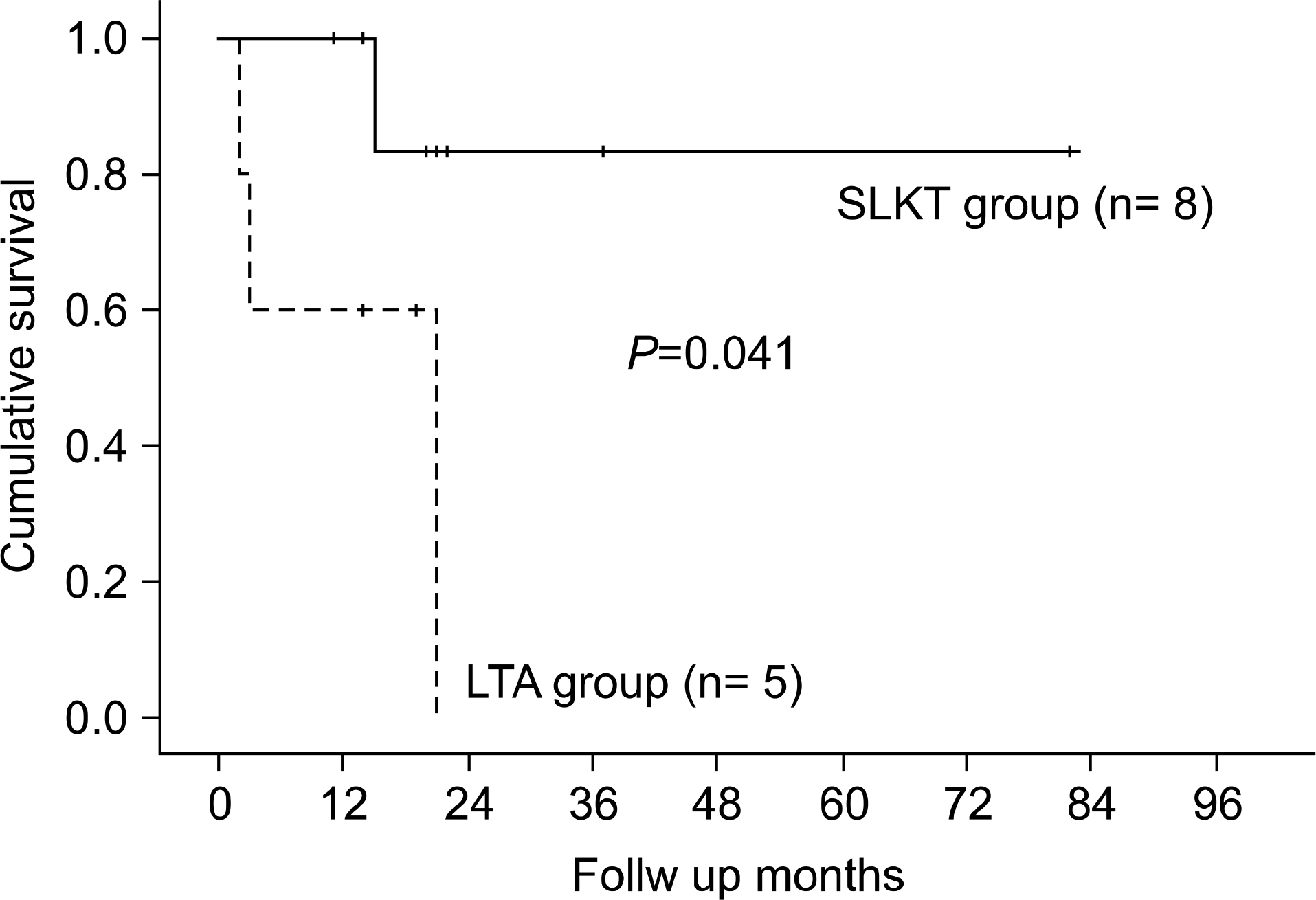
Fig. 1. Differences in patient survival between SLKT and LTA groups. Abbreviations: SLKT, simultaneous liver-kidney transplantation; LTA, liver transplantation alone.
Reference
-
References
1). Margreiter R, Kramar R, Huber C, Steiner E, Nieder-wieser D, Judmaier G, et al. Combined liver and kidney transplantation. Lancet. 1984; 1:1077–8.
Article2). Dube GK, Cohen DJ. Simultaneous liver and kidney transplantation. Curr Opin Nephrol Hypertens. 2007; 16:547–53.
Article3). Eason JD, Gonwa TA, Davis CL, Sung RS, Gerber D, Bloom RD. Proceedings of consensus conference on simultaneous liver and kidney transplantation (SLK). Am J Transplant. 2008; 8:2243–51.4). Locke JE, Warren DS, Singer AL, Segev DL, Simpkins CE, Maley WR. et al. Declining outcomes in simultaneous liver-kidney transplantation in the MELD era: ineffective usage of renal allografts. Transplantation. 2008; 85:935–42.5). Gonwa TA, Mai ML, Melton LB, Hays SR, Goldstein RM, Levy MF, et al. End-stage renal disease (ESRD) after orthotopic liver transplantation (OLTX) using calcineurin-based immunotherapy: risk of development and treatment. Transplantation. 2001; 72:1934–9.6). Chopra A, Cantrarovich M, Bain VG. Simultaneous liver and kidney transplants: optimizing use of this double resource. Transplantation. 2011; 91:1305–9.
Article7). Simpson N, Cho YW, Cicciarelli JC, Selby RR, Fong TL. Comparison of renal allograft outcomes in combined liver-kidney transplantation versus subsequent kidney transplantation in liver transplant recipients: Analysis of UNOS Database. Transplantation. 2006; 82:1298–303.
Article8). Kim MS. Multiple organ transplantation: combined liver-kidney transplantation. J Korean Soc Transplant. 2010; 24:243–7. (김명수. 다장기이식: 간-신장 동시이식. 대한이식학회지 2010;24: 243–7.).
Article9). Korean Network for Organ Sharing (KONOS). 2008 Annual Data report. Seoul: KONUS;2009. p. 28–9. (국립장기이식관리센터. 2008 장기이식 통계연보. 서울: 국립장기이식관리센터; 2009: 28–9.).10). Yoo HY, Thuluvath PJ. Short-term postliver transplant survival after the introduction of MELD scores for organ allocation in the United States. Liver Int. 2005; 25:536–41.
Article11). Baliga P, Merion RM, Turcotte JG, Ham JM, Henley KS, Lucey MR, et al. Preoperative risk factor assessment in liver transplantation. Surgery. 1992; 112:704–10.12). Nair S, Verma S, Thuluvath PJ. Pretransplant renal function predicts survival in patients undergoing orthotopic liver transplantation. Hepatology. 2002; 35:1179–85.
Article13). Hanish SI, Samaniego M, Mezrich JD, Foley DP, Leverson GE, Lorentzen DF, et al. Outcomes of simultaneous liver/kidney transplants are equivalent to kidney transplant alone: a preliminary report. Transplantation. 2010; 90:52–60.
Article14). Starzl TE, Demetris AJ, Murase N, Ildstad S, Ricordi C, Trucco M. Cell migration, chimerism, and graft acceptance. Lancet. 1992; 339:1579–82.
Article15). Sanchez EQ, Klintmalm GB. Combined liver-kidney transplantation. Busuttil RW, Klintmalm GB, editors. Transplantation of the Liver. 2nd ed.Philadelphia: Elsevier Saunders;2005. p. 803–13.
Article
- Full Text Links
-
- Actions
-
Cited
- CITED
-
- Close
- Share
-
- Similar articles
-
- A case series on simultaneous liver and kidney transplantation: do we need intraoperative renal replacement therapy?
- Simultaneous liver-kidney transplantation: a single-center experience in Korea
- Hidden pathology of kidney disease after liver transplantation
- BK polyomavirus infection following COVID-19 infection in renal transplant recipients: a single-center experience
- Simultaneous liver-kidney transplantation: A single-center experience in Korea


